期刊名称:PEDIATRIC ANESTHESIA
 期刊简介(About the journal)
投稿须知(Instructions to Authors)
编辑部信息(Editorial Board) 期刊简介(About the journal)
投稿须知(Instructions to Authors)
编辑部信息(Editorial Board)
About the journal
Aims and Scope
Devoted to the publication of information of interest and importance to practising anaesthetists everywhere, Pediatric Anesthesia aims to be truly international in policy and flavour. The scientific and clinical content of the journal covers a wide selection of medical disciplines in all areas relevant to anaesthesia and intensive care in new-borns, infants and children.
Pediatric Anesthesia has an intercontinental Editorial Board, which is supported by the Editorial Advisory Panel of recognized experts from around the world, to ensure that the journal is publishing the best work from the front line of research in the field. In addition to top-quality scientific and clinical research papers and commissioned commentary articles, there are sections covering case presentations; book reviews; correspondence; reports of local, national and international meetings; and a diary of forthcoming events.

Instructions to Authors
Author Guidelines
SUBMISSION OF MANUSCRIPT
All manuscripts should be submitted online via Manuscript Central - http://mc.manuscriptcentral.com/pan. Full instructions and support are available on the site and a user ID and password can be obtained on the first visit. If you cannot submit online please contact Katherine Wilkinson in the Editorial Office by telephone (0044 (0) 0131 7184457) or by email (kwilkinson@wiley.com)
Each article should be accompanied by a covering letter, signed by the main author, which states the following: 'The enclosed manuscript has been read and approved by all authors, it is not under active consideration for publication elsewhere, has not been accepted for publication, nor has it been published in full or in part (except in abstract form).' It should be noted that review of articles cannot proceed until the signed statement is received.
Submissions should be accompanied by a completed Copyright Transfer Agreement. All authors are required to licence copyright of their manuscript to Wiley-Blackwell. Copyright licensing is a condition of publication and papers will not be passed to the publisher for production unless copyright has been licenced. Permission to reproduce material must be obtained from the Editor. The Editor and Editorial Board do not accept responsibility for the opinions expressed in the journal.
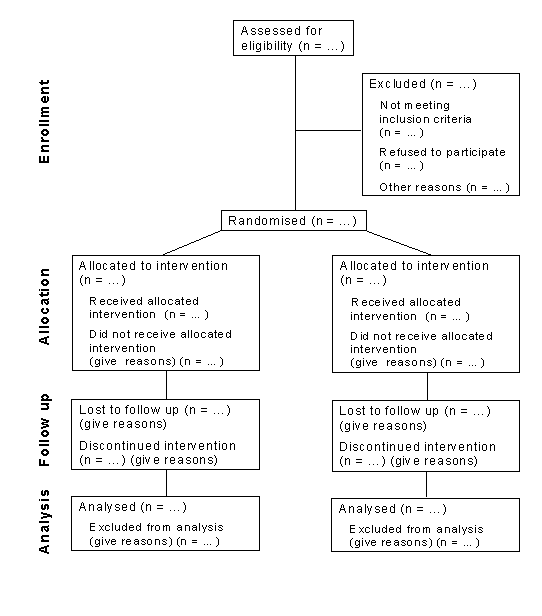
Papers based on clinical investigation must satisfy the Editorial Board that they conform to ethical standards as described in the Declaration of Helsinki. Acceptance of an investigational study by the appropriate ethical committee should be confirmed. Any form of registration which may identify a patient must be excluded from the content of the paper. However, when clinical photographs of patients are submitted, consent by the patient or parent must be obtained prior to submission of the article and is the responsibility of the author. Reports of clinical trials should adhere to the tenets of the CONSORT statement (JAMA 2001; 285: 1987-1991). A flow chart should be provided describing the progress of patients through the trial. A checklist of CONSORT requirements must also be completed. Both forms should be sent to the Editorial Office by post or fax.
Articles will normally be reviewed by two expert referees and the Editor's decision is final. The Editor will acknowledge the assistance of the referees at the end of each volume of the journal.
If your figures contain photographs of a patient, please ensure that the patient has signed the patient consent form. This form is available on request from kwilkinson@wiley.com
Ethics
Manuscripts describing studies involving animals should comply with local/national guidelines governing the use of experimental animals and contain a statement indicating that the procedures have been approved by the appropriate regulatory body. Manuscripts concerned with human studies must contain statements indicating that informed, written consent has been obtained, that studies have been performed according to the Declaration of Helsinki and that the procedures have been approved by a local ethics committee. If individuals might be identified from a publication (e.g. from images) authors must obtain explicit consent from the individual.
The journal's ethical policies are outlined in the separate document "Ethical Policies of Pediatric Anesthesia". Submitted work must comply with these policies, which are based on the Committee on Publication Ethics (COPE) guidelines on good publication and comply with their Code of Conduct (http://www.publicationethics.org.uk/guidelines).
Electronic artwork
All figures should be uploaded as digital files alongside your manuscript on Manuscript Central at http://mc.manuscriptcentral.com/pan. Ideally, these should be sent in native format or EPS for line (vector) diagams or TIFF for anything else (bitmapped images). Avoid using tints if possible; if they are essential to the understanding of the figure, try to make them coarse. Further details can be obtained from http://www.blackwellpublishing.com/bauthors/digill.asp. Disks will not be returned to authors.
Pre-acceptance English-language editing services
Pediatric Anesthesia is pleased to recommend to authors pre-acceptance English-language editing services. Details can be found at http://www.blackwellpublishing.com/bauthor/english_language.asp. The Editor may recommend an English-language editing service to the author as a condition of acceptance.
Authors should keep a copy of their manuscript for reference.
PREPARATION OF TYPESCRIPTS
The typescript should consist of the following sections:
- Title page
- Abstract
- Introduction
- Methods
- Results
- Discussion
- Acknowledgements
- References
- Figures and/or tables
- Legends for figures and/or tables
All papers should be typed double spaced on one side only of A4 paper with a wide margin. The pages should be numbered consecutively beginning with the title page.
TITLE PAGE
The first page should bear the title of the manuscript (which should be brief) and name of the author(s), together with the name of the hospital, laboratory or institution. It should also include the name, email address and full postal address of the author for correspondence; this will appear as a footnote in the journal and the publishers will send the proofs to this author for correspondence; this will appear as a footnote in the journal and the publishers will send the proofs to this author at the given email address unless contrary instructions are written on the manuscript. A running title of no more than 50 characters (including spaces) should be included.
ABSTRACT
This should be a brief account of the subject of no more than 250 words, and for Original Papers be structured with the headings: Objectives, Aim, Background, Methods/Materials, Results and Conclusions. Up to six key words or phrases (for indexing) should be provided below the summary, according to Keywords in Anesthesiology, 3rd Edition, Greene, N.M., Elsevier 1988.
BODY
The body of the manuscript should start on a separate page and should normally be divided into: Introduction, Materials and Methods, Subjects Studies, Results, Discussion, Acknowledgements and References. Headings in the text can be of three types and should be indicated by a circled letter 'A', 'B' or 'C' in the margin. The Editor reserves the right to make literary changes.
WHEN SUBMITTING YOUR MANUSCRIPT, PLEASE ENSURE THAT YOU REFER TO THE GUIDELINES BELOW WHICH EXPLAIN THE STRUCTURE THAT THE VARIOUS TYPES OF MANUSCRIPT MUST TAKE.
PLEASE NOTE THAT THE EDITOR MAY NOT CONSIDER YOUR MANUSCRIPT FOR PUBLICATION IN PEDIATRIC ANESTHESIA IF THESE GUIDELINES ARE NOT MET.
IF YOU ARE UNABLE TO MEET THESE GUIDELINES, PLEASE INCLUDE YOUR REASONING WITHIN YOUR COVER LETTER.
Original Articles
- Original articles should contain a structured abstract of no more than 250 words rather than a summary with the following headings: Objectives, Aim, Background, Methods/Materials, Results, Conclusion.
- Articles should be no longer than 2500 words with a maximum of 25 references. Many articles may be considerably shorter. In submitting a manuscript the author should confirm whether these guidelines have been met or not.
- There should be no more than six tables or figures. Further figures and tables can be made available on the web version of the journal. Please label these supplementary figures/tables as S1, S2, S3, etc.
Correspondence
- Letters to the editor are encouraged, particularly if they comment, question or criticize original articles that have been published in the journal.
- Please ensure that your correspondence article includes the following information: Title of correspondence articles, list of author names, author affiliation details, and correspondence details particularly e-mail address.
- Such letters should normally be no longer than 800 words with one table/figure and up to five references. These may include case reports. These do not include abstracts. Further figures and tables can be made available on the web version of the journal. Please label these supplementary figures/tables as S1, S2, S3, etc.
Review Articles
- Review articles should contain a summary and be no longer than 3000 words and contain no more than six figures or tables. If you submit a review article that is longer than this maximum number of words, then please explain your reasoning for doing so in your cover letter. Further figures and tables can be made available on the web version of the journal. Please label these supplementary figures/tables as S1, S2, S3, etc.
Case Reports
- We receive a very large number of case reports and unfortunately, in line with our current policy, only exceptional papers will be accepted.
- Case reports should be submitted in a shortened form that could be considered for publication in Pediatric Anesthesia in our correspondence section. Such a submission should be a maximum of 1000 words in length, may include one table/figure and no more than five relevant references. Further figures and tables can be made available on the web version of the journal. Please label these supplementary figures/tables as S1, S2, S3, etc.
Symbols, Abbreviations and Statistics
Symbols and abbreviations should follow the conventions described in Units, Symbols and Abbreviations: A Guide to Biological and Medical Editors and Authors (1988) Ed. D. N. Baron, published and available from the Royal Society of Medicine, 1 Wimpole Street, London W1M 8AE, or where more appropriate may be reported in traditional units, e.g. pressures should be identified as mmHg or cm H2O. Numbers are written in full to nine, numerals are used from 10 upwards. Abbreviations must be written in full at the beginning of a sentence. The 24-hour clock is used. Statistical methods should be defined and any not in common use should be described in detail or supported by refernces.
Acknowledgements
These should be brief and must include reference to sources of financial and logistical support.
References in Text
References to articles, chapters, monographs or other publications in the text should be in the Vancouver style, i.e. they should be numbered consecutively (by arabic numerals in parentheses) in the order in which they are first mentioned. References cited only in legends should be numbered in accordance with a sequence established by the first identification in the text of the particular table or illustration. Lists of references should start on a new page. The references themselves should be abbreviated according to the style used in Index Medicus. More than three authors to a paper should be abbreviated to et al.
Unpublished observations and personal communications should not be listed but may be inserted in the text. Papers which have been accepted for publication should be included in the list of references as 'in press'. Authors are responsible for verifying the wording of all references and that references of unpublished work are approved by the original author.
Examples of references:
1 Rees GJ. Anaesthesia in the newborn. Br Med J 1950; 2: 1419-1422.
2 Hatch DJ, Sumner E, Hellman J. The Surgical Neonate: Anaesthesia and Intensive Care, 3rd edn. London: Edward Arnold, 1994: 120-125.
3 Motoyama EK. Respiratory physiology in infants and children. In: Motoyama EK, Davis PJ, eds. Smith's Anesthesia for Infants and Children, 5th edn. St. Louis: C.V. Mosby, 1990:11-76.
References in Articles
We recommend the use of a tool such as EndNote (http://www.endnote.com/) or Reference Manager (http://www.refman.com/) for reference management and formatting.
EndNote reference styles can be searched for here: http://www.endnote.com/support/enstyles.asp
Reference Manager reference styles can be searched for here: http://www.refman.com/support/rmstyles.asp
Tables and Figures
All figures and tables should be uploaded as a separate file and appear at the end of the paper following the references. Legends to figures (both line and half-tone) and tables should be uploaded as a separate file and appear in the typescript following the figures/tables.
Cost of colour reproduction of artwork
It is the policy of Pediatric Anesthesia for authors to pay the full cost for the reproduction of their colour artwork. If you would like for your figures or tables to appear in colour please sign and complete the Colour Work Agreement Form when you submit your work. This form can be downloaded as a PDF* from the internet. The web address for the form is:
http://www.blackwellpublishing.com/pdf/SN_Sub2000_P_CoW.pdf
If you are unable to access the internet, or are unable to download the form, please contact the Editorial Assistant at the address below, and they will be able to email or fax a form to you.
Once completed, please return the form either by fax or by post to the Editorial Assistant:
Katherine Wilkinson
Pediatric Anesthesia
Wiley-Blackwell
101 George Street
Edinburgh
EH2 3ES
United Kingdom
Fax: +44 (0)131 2263803
Alternatively, please scan the form and return as an email attachment to kwilkinson@wiley.com.
Any article received by Blackwell Publishing with colour work will not be published until the form has been returned.
* To read PDF files, you must have Acrobat Reader installed on your computer. If you do not have this program, it is available as a free download from the following web address:
http://www.adobe.com/products/acrobat/readstep2.html
Correspondence and Notices
Letters to the Editor should conform with the above conventions and should be sent with a covering letter including names and degrees of each author, and must be signed personally by all participants.
Proofs
One copy of the proofs will be sent to the first named or designated author and one should be returned within 48 hours of receipt to avoid delay in publication. Overseas contributors should ensure that a rapid airmail service is used.
Offprints
Authors will be provided with electronic offprints of their paper. Paper offprints may be ordered at prices quoted on the order form that accompanies proofs, provided that the form is returned with the proofs. The cost is more if the order form arrives too late for the main print run. Offprints are normally dispatched within three weeks of publication of the issue in which the paper appears. Please contact the publisher if offprints do not arrive: however, please note that offprints are sent by surface mail, so overseas orders may take up to six weeks to arrive. Electronic offprints are sent to the corresponding author at his or her first email address on the title page of the paper, unless advised otherwise; therefore please ensure that the name, address and email of the receiving author are clearly indicated on the manuscript title page if he or she is not the first author of the paper. NEW: Online production tracking is now available for your article through Blackwell's Author Services.
Author Services enables authors to track their article - once it has been accepted - through the production process to publication online and in print. Authors can check the status of their articles online and choose to receive automated e-mails at key stages of production so they don't need to contact the production editor to check on progress. Visit www.blackwellpublishing.com/bauthor for more details on online production tracking and for a wealth of resources including FAQs and tips on article preparation, submission and more.
Editorial Board
Editorial Information
EDITOR
N.S. Morton (Glasgow, UK)
ASSISTANT EDITOR
C.J. Cot茅 (and Section Editor) (Boston, USA)
SECTION EDITORS
B. Anderson (Auckland, New Zealand)
A.T. B枚senberg (Cape Town, South Africa)
A. Davidson (Melbourne, Australia)
G.B. Hammer (Stanford, USA)
J. Lerman (Buffalo, USA)
P.A. L枚nnqvist (Stockholm, Sweden)
PRO-CON DEBATE MODERATOR
A.R. Wolf (Bristol, UK)
FOUNDING EDITOR
G.H. Bush (Liverpool, UK)
EDITORIAL BOARD
R. Friesen (Chair) (Denver, USA)
B. Brandom (Statistics Advisor)(Pittsburgh, USA)
I. Murat (Developing World Advisor)(Paris, France)
D. B. Andropolous (Texas, USA)
W. Habre (Geneva, Switzerland)
G. Ivani (Turin, Italy)
A. Kinder-Ross (North Carolina, USA)
D. Kurth (Cincinnati, USA)
P. Marhofer (Vienna, Austria)
J. Tobias (Missouri, USA)
F. Veyckemans (Brussels, Belgium)
M. Crawford (Toronto, Canada)
EDITORIAL ADVISORY BOARD
P. Crean (Belfast, UK)
R. Eyres (Melbourne, Australia)
F. Frei (Basel, Switzerland)
J. Holzki (Cologne, Germany)
J. Keneally (Sydney, Australia)
P.C. Laussen (Boston, USA)
G. Meakin (Manchester, UK)
K. Nilsson (Gothenburg, Sweden)
M. Rawicz (Warsaw, Poland)
T. Yemen (Charlottesville, USA)
M. Ansermino (Vancouver, Canada)
A. McEwen (London, UK)
I. Walker (London, UK)
D. Baines (Sydney, Australia)
B. Von-Ungen Sternberg (Perth, Australia)
S. Malviya (Michigan, USA)
S. Suresh (Chicago, USA)
J. Cravero (Lebanon, New Hampshire, USA)
D. Polaner (Denver, USA)
T. Hansen (Odense, Denmark)
R. Jacob (Vellore, India)
M. Karmaker (Hong Kong, China)
S. Soriano (Boston, USA)
EDITORIAL OFFICE
Wiley-Blackwell
101 George Street
Edinburgh
EH2 3ES
United Kingdom
Katherine Wilkinson
Email: kwilkinson@wiley.com
Tel: +44 (0) 131 718 4257
Fax: +44 (0) 131 226 3803
| 









 刊名字顺( Alphabetical List of Journals):
 返回页首
返回页首