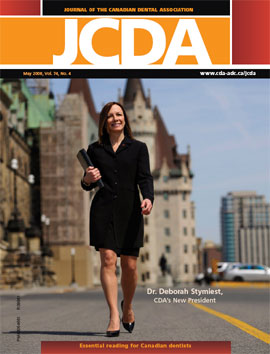
期刊名称:JOURNAL OF THE CANADIAN DENTAL ASSOCIATION
|
ISSN: | 1488-2159
|
|
出版频率: | Monthly
|
|
出版社: | CANADIAN DENTAL ASSOC, 1815 ALTA VISTA DRIVE, OTTAWA, CANADA, ON, K1G 3Y6
|
|
期刊网址: | http://www.cda-adc.ca/jcda/
| |
影响因子: | 0.929(2008) |
| 主题范畴: | DENTISTRY, ORAL SURGERY & MEDICINE |
| 变更情况: | 2007new |
 期刊简介(About the journal)
投稿须知(Instructions to Authors)
编辑部信息(Editorial Board) 期刊简介(About the journal)
投稿须知(Instructions to Authors)
编辑部信息(Editorial Board)
About the journal
Mission Statement
The Journal is the authoritative written voice of the Canadian Dental Association providing dialogue between the national association and the dental community. It is dedicated to publishing worthy scientific and clinical articles and informing dentists of issues significant to the profession.
Instructions to Authors
Information for Authors
Introduction
The paper version of the Journal of the Canadian Dental Association (JCDA) has a monthly circulation of over 19,000 copies, and reaches all dentists and dental students in Canada as well as subscribers outside the country. The electronic version of the JCDA is at http://www.cda-adc.ca/jcda . The JCDA is indexed on Medline and in Index Medicus. The JCDA endorses the uniform requirements for manuscripts submitted to biomedical journals (http://www.icmje.org/) and the CONSORT statement relating to improving the quality of reports of randomized clinical trials (www.consort-statement.org). Authors are advised to read these requirements.
Authors writing for the JCDA should note that the majority of its readers are general dental practitioners. Specialists and clinical researchers should therefore direct their articles to this audience.
Scope of the Journal
The Journal is a general dental journal concerned with science-based clinical practice and the major issues (e.g., clinical, demographic, educational, ethical, legal and regulatory) facing the dental profession.
Types of manuscripts accepted
Applied Research
Original submissions reporting findings of clinical research projects. Submitted papers must be pertinent to clinical decision making. The text, excluding abstract and references, must not exceed 2,500 words.
Clinical Practice
Submissions, in various formats, related to the practice of clinical dentistry. Clinicians may submit systematic review articles, case reports, topic updates or creative solutions to clinical problems they have encountered in practice. The length of papers should not exceed 2,500 words.
Professional Issues
This section of the Journal aims to help the dental practitioner understand and adapt to the changing professional environment. Articles that propose solutions to the problems posed by the changes in our professional environment are invited. Topics within the scope of this section include demographics, dental education, dental ethics, epidemiology, health policy and professional regulation. Manuscripts must not exceed 2,500 words.
Debate
This section provides a forum for the expression of opinions by people with an interest in the promotion of optimum oral health in Canada. These opinions may be provocative, even iconoclastic, yet they are put forward in the sincere hope of promoting new ways of examining issues facing the dental profession. Debate pieces should be no longer than 1,200 words.
Letters
Brief Letters to the Editor (300 words maximum) on topics related to clinical dentistry and the environment in which dentistry is practised.
Clinical Abstracts
The Clinical Abstracts section features abstracts and summaries from peer-reviewed dental publications. It attempts to make readers aware of recent literature that may be of interest to oral health care workers. [ more ]
Clinical Showcase
Clinical Showcase is a series of pictorial essays that focus on the technical art of clinical dentistry. This section features step-by-step case demonstrations of clinical problems encountered in dental practice. [ more ]
Point of Care
Point of Care answers everyday clinical questions and is designed to provide practical information at the point of patient care. [ more ]
Prior to manuscript preparation
Potential authors are invited to contact the editor Dr. John O'Keefe to discuss ideas for manuscripts at 1-800-267-6354, ext. 2297 (in Canada), or (613) 523-1770, ext. 2297 (from outside Canada), or to send an e-mail to jokeefe@cda-adc.ca . Manuscripts may be submitted in paper or electronic format.
Top
Preparing your manuscript (paper format)
Type the manuscript on 8 1/2" x 11" paper with margins of one inch on all sides. Use double spacing throughout and arrange the manuscript in the following sequence, with each section beginning on a new page: title page; abstract; text; acknowledgments; references; individual tables and figure legends. Number pages consecutively, in the upper right-hand corner, beginning with the title page. To accommodate blinded peer review, place the names of authors only on the cover page.
TITLE PAGE
This page should contain the title; each author's name, academic degrees, institutional affiliation and address; and the postal address, fax, telephone and e-mail of the author responsible for correspondence about the manuscript. Sources of support in the form of grants, equipment or drugs should be mentioned in a footnote. Include the word count for the text on the title page.
ABSTRACT
Include a structured abstract of up to 250 words for research articles and systematic reviews, and up to 150 words for other types of articles, depending on the length of the text. The abstract should be factual, not descriptive, giving the main points of the paper.
TEXT
The average article in JCDA contains six to eight manuscript pages of text (approximately 1,500 to 2,000 words), not including title page, abstract, tables, reference list, etc. Manuscripts longer than 2,500 words will not be accepted.
ACKNOWLEDGMENTS
You may acknowledge professional help in the preparation or review of your manuscript.
REFERENCES
Emphasize recent references (past five years). In general, avoid references older than 10 years, letters to the editor or editorials. Do not use abstracts, unpublished observations, manuscripts in preparation or submitted for publication, personal communications or references from journals that our readers will have difficulty accessing.
To avoid plagiarism, be sure not to use the language, content or concepts of another source without appropriate citation. Do not use extensive verbatim or near verbatim portions of text from another source, even with appropriate citation.
Number references in the text in the order of citation. Arrange them numerically, not alphabetically, in the reference list, which should be double-spaced. Follow the style used in Index Medicus. Do not exceed 35 references. In the text, references should be superscript (please do not use Footnote function).
References first cited in tables or figure legends must be numbered so that they will be in sequence with references cited in the text.
Note the following examples of reference style:
Standard journal article
1. Tam L. Clinical trial of three 10% carbamide peroxide bleaching products. J Can Dent Assoc 1999; 65(4):201-5.
2. Feine JS, de Grandmont P, Boudrias P, Brien N, LaMarche C, Tach?R, and others. Within-subject comparisons of implant-supported mandibular prostheses: choice of prosthesis. J Dent Res 1994; 73(5):1105-11.
Top
Chapter in a book
1. Banting DW. Management of dental caries in the older patient. In: Papas AS, Niessen LC, Chauncey HH, eds. Geriatric dentistry: aging and oral health. St. Louis: Mosby Year Book Inc.; 1991:141-67.
Please note that no periods are used after authors' initials or journal abbreviations, and that "and others" is used after the sixth author's name when there are more than six authors. Include beginning and ending page numbers for journal and book references.
ILLUSTRATIONS (TABLES AND FIGURES)
Number tables and figures sequentially with arabic numerals (e.g., Table 1, Figure 1) and reference them at the appropriate places in the text.
Give complete reference data and include photocopies of all tables and figures taken or adapted from other sources.
Tables
Tables should be understandable without reference to the text. They should not duplicate the text. Type each table double-spaced on a separate sheet of paper and include a title.
Top
Figures
JCDA encourages the submission of original artwork that highlight the text. Photographs in which patients are identifiable must be accompanied by the subjects' written permission to publish the photographs.
Symbols, lettering and arrows in figures should be clear and large enough to remain legible if the illustration is reduced when published. On the back of each photograph or slide, use a self-adhesive label to indicate the figure number, the author's last name and the proper orientation (i.e., "top"). Do not use paper clips or write on the back of photographs.
Type figure legends double-spaced on a separate sheet of paper.
STYLE GUIDELINES
JCDA style guidelines are available from Ms. Rachel Galipeau ( rgalipeau@cda-adc.ca ) at 1-800-267-6354, ext. 2221 (in Canada), or (613) 523-1770, ext. 2221 (from outside Canada).
Use of Proprietary Names. Generic names should be used for all drugs and materials. When a trade name must be used, cite (in parentheses) the name, city, state/province and country of the manufacturer.
Text Formatting. For papers prepared on a word processor, note the following guidelines: (1) Use plain text with no special formatting. (2) Do not justify the right margin. (3) Use bold print, italics and underlining sparingly. (4) Use a single, standard typeface of letter quality.
Top
Sending your manuscript
Send the manuscript and two clear copies to Dr. John P. O'Keefe, Editor, Journal of the Canadian Dental Association, 1815 Alta Vista Drive, Ottawa, Ontario, Canada K1G 3Y6. Send three sets of all materials, including illustrations.
COVER LETTER
Include in the cover letter a statement that the manuscript is original, that it has not been published previously and is not under consideration for publication elsewhere, and that the final version has been seen and approved by all authors.
COPYRIGHT TRANSFER
All manuscripts that are accepted for publication become the permanent property of the Canadian Dental Association and may not be published elsewhere without written permission from CDA.
A Copyright Transfer Statement will be sent to the corresponding author upon receipt of the manuscript. This statement should be signed by all authors and returned as soon as possible to CDA.
CONFLICT OF INTEREST
The CDA expects authors to disclose any commercial association that might pose a conflict of interest in connection with the submitted paper. All funding sources supporting the work should be acknowledged.
A Financial Disclosure Statement will be sent to the corresponding author upon receipt of the manuscript. This statement should be signed by all authors and returned as soon as possible to CDA.
Manuscripts will not be sent for review until the editor receives signed financial disclosure and copyright transfer statements.
Top
The review process
- Article is submitted to CDA head office, addressed to the Editor.
- The editor reviews the manuscript and decides to accept for review, send back for modification before re-submission or reject outright.
- The editor picks two reviewers who are expert in the particular clinical or scientific discipline.
- The editor contacts reviewers by telephone, fax or e-mail to check their availability and willingness to review.
- The editor sends the manuscript (with identity of authors removed) to reviewers, with request that reviewer comments be back to Editor in three weeks. The manuscript is accompanied by a covering letter that explains the review criteria.
- Some manuscripts are sent to an expert statistician for review.
- When the comments of the expert reviewer come back, the Editor decides whether to accept, accept with modifications or reject the manuscript. This decision is based on the quality, importance and relevance of the manuscript. The Editor has the final decision on the acceptance of the manuscript.
- The Editor communicates the acceptance decision to the authors and advises of next steps.
- The authors re-submit the modified manuscript to the Editor. In some cases, the manuscript may need to be looked at again by a technical expert.
- Article is sent for copy-editing.
Electronic submission
As an alternative to paper format, documents may be submitted by e-mail. Authors are asked to discuss this with the Editor prior to submission. Images submitted electronically should be in a TIFF format at 300 dpi and should conform to the standard size for Journal figures (i.e., 2 1/4 X 31/3")
Top
Checklist for Authors
Incomplete submissions will be returned to the author. Please ensure your submission includes the following:
- original and two copies of article
- title of article (on original and all copies)
- full name(s), academic degree(s), affiliation(s) and titles of author(s) on title page of the original manuscript only, not on copies
- author to whom correspondence, galleys and reprint requests are to be sent, including address and business telephone, fax and e-mail
- word count of the text alone and word count of the entire manuscript provided
- structured abstract (double-spaced) including three or four MeSH key words (Medical Subject Headings used by Medline) for your article
- article proper (double-spaced)
- references (double-spaced, on a separate sheet) (Please include the first page of each article cited to facilitate verification of references.)
- tables (double-spaced, on separate sheets)
- legends (double-spaced, on a separate sheet)
- illustrations, properly labelled (three sets of glossy prints)
- source of funding for research
- permission to reproduce previously published material
- permission to publish photographs of identifiable persons
- an IBM-compatible diskette containing the manuscript (preferably prepared in WordPerfect for Windows or Microsoft Word).
Please review this checklist carefully before submitting your manuscript to ensure its completeness and conformity with JCDA style.
Our neighbors at the Canadian Medical Association provide a wealth of useful information for potential authors at their Medical Writing Centre.
Copyright Transfer Agreement & Financial Disclosure Statement
Editorial Board
Editoral.pdf
| 









 刊名字顺( Alphabetical List of Journals):
 返回页首
返回页首 