期刊名称:PHYSICA STATUS SOLIDI A-APPLIED RESEARCH
 期刊简介(About the journal)
投稿须知(Instructions to Authors)
编辑部信息(Editorial Board) 期刊简介(About the journal)
投稿须知(Instructions to Authors)
编辑部信息(Editorial Board)
About the journal
|
PHYSICA STATUS SOLIDI A-APPLIED RESEARCH
The aim of physica status solidi is the rapid publication of important and new results in the field of solid state physics, both in fundamental and applied research. physica status solidi (a) and physica status solidi (b) are published in 15 issues (6 volumes) per year. The new series physica status solidi (c) - conferences is published with several issues in 2003.
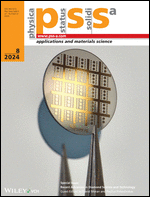
physica status solidi (a) - applied research covers materials science and applications including growth and preparation techniques, solid-state diagnostics and other methodical aspects, solid-state phase transitions, device-related phenomena etc. |
 | physica status solidi (b) - basic research is devoted to topics such as electronic states and transitions, lattice dynamics, disordered, low-dimensional and organic solids, surfaces, high-excitation phenomena etc.
physica status solidi (c) - conferences publishes conference proceedings, ranging from large international meetings to specialized topical workshops.
Papers are grouped into the following categories:
?SPAN style="FONT: 7pt 'Times New Roman'"> Feature and Review Articles
?SPAN style="FONT: 7pt 'Times New Roman'"> Rapid Research Notes
?SPAN style="FONT: 7pt 'Times New Roman'"> Original Papers
In the (a) and (b) print issues, Original Papers are classified into eight thematic subsections: structure and lattice properties; surfaces, interfaces, thin films; nonelectronic transport; electronic states, low-dimensional systems; electronic transport, superconductivity; magnetic properties, magnetic resonances; dielectric and optical properties; device-related phenomena.
physica status solidi also publishes topical special issues and conference proceedings.
For further information see the author instructions.
physica status solidi is abstracted/indexed in:
?SPAN style="FONT: 7pt 'Times New Roman'"> Cambridge Scientific Abstracts
?SPAN style="FONT: 7pt 'Times New Roman'"> Chemical Abstracts, SciFinder
?SPAN style="FONT: 7pt 'Times New Roman'"> Current Contents/Physical, Chemical and Earth Sciences
template and style sheet packages.
How to submit
Please submit your manuscript electronically to one of the Regional Editors or to the pss Editorial Office:
- as e-mail attachment to
pss@wiley-vch.de (Rapid Research Notes to pss.rapid@wiley-vch.de)
or
- via our online submission system at http://webeos.wiley-vch.de/osm/
- Only if your file is too big to be sent via e-mail or web, send a CD-ROM to Wiley-VCH, pss, B黨ringstra遝 10, 10249 Berlin, Germany.
Rapid Research Notes
For submission of three-to-four page manuscripts and fast peer-reviewed online publication within 14 days in the express letter journal of pss, see http://rapid.physica-status-solidi.com.
File format
- Please submit your manuscript exclusively as ONE SINGLE readable DOC, PDF, or Postscript file. You need to embed ALL figures and tables within this file.
- After the manuscript is accepted for publication you will be asked to send the original source files (i.e., DOC or LaTeX).
Manuscript format
- Please format your manuscript using the pss style files:
Doc style file
LaTex style file
- PACS codes: Please provide up to six PACS numbers within the manuscript text (commonly placed before the abstract paragraph). Please use the current PACS 2003 list at http://www.aip.org/pacs/.
- Fonts: Please use Times New Roman, Times, Arial, Helvetica, or Symbol fonts as much as possible. Some fonts (e.g. Asian or Russian character fonts) may cause problems and should be avoided.
What happens after submission?
You will receive a confirmation of submission via e-mail. Please allow a few days before assuming you did not get a sufficient response. Your manuscript will usually be sent to two referees for review.
Tracking your manuscript's status
You can track your manuscript's status online at http://www.wiley-vch.de/home/pss-status.
Acceptance stage
The Editorial Office will send an acceptance message to the corresponding author and, at the same time, will ask for any missing electronic files of text and figures. The corresponding author will be informed in this message in which series of physica status solidi the paper will be published. All portions of the manuscript available in electronic form should be sent to the production department:
for series (a) pssa.corr@wiley-vch.de,
for series (b) pssb.corr@wiley-vch.de,
for series (c) pssc.corr@wiley-vch.de.
Preferably, files conforming to the following guidelines will be accepted:
?Word files coded with the pss_2000.dot file available from pss_word.zip
?LaTeX files coded with the pss-style sheets available from pss_latex.zip (also including all necessary additional information on how to use the style files)
?figures in Postscript (ps or eps) or tif format should be included as separate files
?supplementary material, for example videos or animations (which will only be published in the online version)
Also accepted:
?LaTeX files coded with the article class without any particular packages or definitions
All files should be archived and compressed into a single file using WinZip or tar.gz before e-mailing. Please note that colour figures will generally only remain in colour in the electronic version, but will be printed in black/white. Colour figures for the printed version can be purchased using the reprint order form.
Proof correction stage
Prior to publication, authors of Feature and Review Articles as well as Original Papers will receive page proofs, preferably by e-mail in PDF format. Authors should keep in mind that reading proofs is their responsibility. Corrections should therefore be clear and complete. Corrections listed in an electronic file should be sorted by line numbers. The use of standard proof correction marks is recommended. LaTeX and Word files are sometimes slightly modified during production department to follow the general presentation rules of the journal. The main aim of proofreading is to correct errors that may have occurred during the production process, and not to modify the content of the paper. The reproduction of art work, the layout of the pages and breaks in equations introduced by the production staff should carefully be checked. Corrections that may lead to a change in the page layout should be avoided. Note that sending back a corrected manuscript file is of no use.
Please correct your galley proofs and return them within 7 days together with the completed reprint order form and the signed copyright agreement. The editors reserve the right to publish an article as is if corrected proofs do not arrive in time.
Reprints
The corresponding author will receive a PDF file (300 dpi) for 50 printouts of his contribution free of charge. Hardcopy reprints (at least 50 copies) or a PDF file (300 dpi) for an unlimited number of printouts are available for purchase.
Editorial Board
Editor in Chief
M. STUTZMANN
Walter-Schottky-Institut, Technische Universit鋞 M黱chen,
Am Coulombwall, 85748 Garching, Germany;
Telephone: (+49 89) 2891-2760; Fax: (+49 89) 2891-2737;
e-mail: stutz@wsi.tu-muenchen.de
Regional Editors
M. S. BRANDT
Walter-Schottky-Institut, Technische Universit鋞 M黱chen,
Am Coulombwall, 85748 Garching, Germany;
Telephone: (+49 89) 2891-2758; Fax: (+49 89) 2891-2737;
e-mail: mbrandt@physik.tu-muenchen.de
P. DE罧
Department of Atomic Physics, Technical University of Budapest,
Budafoki ut 8, H-1111 Budapest, Hungary;
Fax: ++[36]-(1)-463-4357; e-mail: p.deak@goliat.eik.bme.hu
J. R. LEITE
Instituto de F韘ica da Universidade de Sa?Paulo,
CP 66318, Sa?Paulo, SP, CEP 05315-970, Brazil;
Fax: +55-11-30916984; e-mail: jrleite@if.usp.br
J. I. B. WILSON
Department of Physics, Heriot Watt University,
Riccarton, Edinburgh EH14 4AS, UK;
Fax: +44-131-451-3136; e-mail: j.i.b.wilson@hw.ac.uk
Editorial Office
S. Hildebrandt, R. Schulz
WILEY-VCH Verlag GmbH & Co. KGaA,
B黨ringstra遝 10,
13086 Berlin, Germany;
Fax: +49 (0) 30 / 47 03 13 34;
e-mail: pss@wiley-vch.de
Editorial and Advisory Boards
physica status solidi (a) ?Editorial Board:
S. AMELINCKX, Mol-Donk; J. AUTH, Berlin; K.W. B諩R, Newark; J.M. COWLEY, Tempe/Arizona; G. LEISING, Graz; G.O. M躄LER, San Jose Alto; A. SEEGER, Stuttgart; M. STUTZMANN (Editor-in-Chief), Garching; J.I.B. WILSON, Edinburgh.
physica status solidi (a) ?Advisory Board:
W. ANDR? Jena; H. B腟SLER, Marburg; E. BAUER, Tempe; G. CHIAROTTI, Rome; H. CURIEN, Paris; R. GRIGOROVICI, Bucharest; J. HEYDENREICH, Halle; A.A. KAMINSKII, Moscow; Y. NAKAMURA, Kyoto; J. NIHOUL, Leuven; T.N. RHODIN, Ithaca.
physica status solidi (b) ?Editorial Board:
P. AIGRAIN, Paris; S. AMELINCKX, Antwerp; M. BALKANSKI, Paris; M. CARDONA, Stuttgart; P. DE罧, Budapest; R. KAISCHEW (deceased), Sofia; P.T. LANDSBERG, Southampton; L. PAL, Budapest; A. SEEGER, Stuttgart; F. SEITZ, New York; M. STUTZMANN (Editor-in-Chief), Garching; W. ZAWADZKI, Warsaw.
physica status solidi (b) ?Advisory Board:
M. AVEROUS, Montpellier; M. BERNARD, Bagneux; W. HAUBENREISSER, Jena; H.-G. KAHLE, Karlsruhe; M. MATYAS, Prague; H.D. MEGAW, Cambridge; W. STEINMANN, Munich; H.-R. TREBIN, Stuttgart; I.M. TSIDILKOVSKI, Ekaterinburg; R. VAUTIER, Bellevue/Seine.
| 









 刊名字顺( Alphabetical List of Journals):
 返回页首
返回页首 