期刊名称:NEW DIAMOND AND FRONTIER CARBON TECHNOLOGY
|
ISSN: | 1344-9931
|
|
版本: | SCI-CDE
|
|
出版频率: | Bimonthly
|
|
出版社: | MYU K K, SCIENTIFIC PUBLISHING DIV,2-32-3 SENDAGI,BUNKYO-KU, TOKYO, JAPAN, 113
|
|
出版社网址: | http://www.myu-inc.jp/
|
|
期刊网址: | http://www.myu-inc.jp/myukk/NDFCT/
| |
影响因子: | 0.5(2008) |
| 主题范畴: | MATERIALS SCIENCE, COATINGS & FILMS; MATERIALS SCIENCE, MULTIDISCIPLINARY |
 期刊简介(About the journal)
投稿须知(Instructions to Authors)
编辑部信息(Editorial Board) 期刊简介(About the journal)
投稿须知(Instructions to Authors)
编辑部信息(Editorial Board)
About the journal
New Diamond and Frontier Carbon Technology
|
| New Diamond and Frontier Carbon Technology is an international journal that aims to serve the global scientific and engineering community with the latest information on the science and technology of new diamond and frontier carbon materials. Materials which fall within the scope of the Journal are diamond, cBN and DLC as well as the newly emerging "frontier carbon" materials including fullerenes, nanotubes and other forms of B-C-N compounds. The topics covered in the Journal will include synthesis technology, characteristics and applications of mechanical, thermal, optical, electrical/electronic, | |
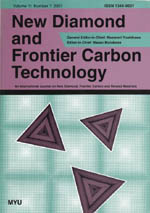
| chemical/electrochemical, medical and other new properties, process simulations and modelings, deposition system engineering, economic analysis, etc. It is the editors' wish that the Journal will accelerate the exchange of information and experience among the readers to enable the advent of new scientific findings and practical applications, using the unique and excellent properties possessed by new diamond and frontier carbon materials, into the 21st century. New Diamond and Frontier Carbon Technology is published as a successor to Diamond Films and Technology, which was published from Volume 1 through Volume 8.
Instructions to Authors
|
Manuscripts |
| Papers submitted to this journal must not have been previously published or be currently under consideration for publication elsewhere. Manuscripts must be typed (double-spaced) on 8.5 x 11 inch or A4 white sheets. Only one side of each sheet should be used and the text should be surrounded by a 1.5 inch margin (approximately). The manuscript must be submitted in quadruplicate: one original and three copies including illustrations and tables. Manuscripts may be submitted to the publisher or directly to the Editor-in-Chief or one of the Associate Editors. Upon acceptance of manuscript for publication, the author(s) will be obliged to purchase at least 100 copies (as of 2003, this cost will be 65,000 Japanese Yen for a paper 8 pages long in NDFCT format). |
|
| Type of articles |
| Contributions should be specified as either research papers, review papers, letters or technical notes, which are peer-reviewed, or news. In principle, papers are generally published approximately three months after the date of acceptance of the paper. For letters, rapid publication is standard. |
|
| Title page |
| The first page should be arranged in the following manner: title, names of authors (first names in full), academic and professional affiliations of the authors, one address for correspondence and e-mail address(es). No abbreviations/acronyms allowed in title. |
|
| Text |
| The text should be arranged as follows: Abstract (approximately 200 words, in the form of one paragraph), Key words (three to five words, no abbreviations or acronyms), Introduction, Materials and Methods, Results, Discussion, Conclusions, Acknowledgments, References, and Figure and Table legends; although some flexibility of presentation is allowed. Abbreviations or acronyms used for the first time in the abstract and the text should be spelled out in full. Use International System of Units (SI) throughout. (m, kg, s, Hz, N, Pa, A, V, Ω, K, mol, cd, etc.) Commas should not be used as decimal points. |
|
| Tables |
| Tables should include a short descriptive title. Each table should be typed on a separate sheet of paper. They should be numbered sequentially using Arabic numerals, such as 1, 2, 3, 4, etc. |
|
| Figures |
| Illustrations should be in black ink, and all lettering must be done professionally. Photographs should be submitted as clear black-and-white prints on glossy paper. All figures should be numbered sequentially using Arabic numerals. Letters, numbers and symbols should be clearly printed. Figures in the journal range in size from approximately 3 x 4 cm (minimum) to 12 x 18 cm (maximum). If the original figures or the figure legends are large, they will be reduced according to the following rules: 1) the size of each letter of the figure legends is approximately 2 mm or larger (only the first letter is upper case); 2. symbols, such as œ, and ¢ in the figure are approximately 1 mm in size; 3. The coordinates and the lines enclosing the graphs are approximately 0.2 mm wide. Units used in the label should be enclosed in parentheses (e.g., Pressure (Pa), Intensity (arb. units), etc.). Even if authors submit figures in electronic format, be certain to include camera-ready printout as well. Illustrations or photographs may be printed in color. In this case, the author shall have to bear the extra costs involved. For further information regarding color printing, please contact the publisher. |
|
| References |
Only published works and manuscripts that have been accepted for publication may be listed in the References. Avoid citing a "personal communication " unless it provides essential information not available from a public source, in which case the name of the person and the date of communication should be cited in parentheses in the text. References should be numbered consecutively and listed on a separate sheet. In the text, each reference should be denoted by the corresponding number on the list as a superscript in parentheses (e.g., new diamond(1) and frontier carbon technology(2-4)). Position reference numbers after a punctuation mark if present. Avoid the use of "et al.," if possible in the reference list. Please refer to the following examples.
-Proceedings:
1) J. Shirafuji, Y. Sakamoto, A. Furukawa and T. Sugino: Recent Progress in Diamond Electronics, Proc. 1st Int. Symp. Diamond Electronics Devices, Eds. S. Rotter and A. Hiraki (MYU, Tokyo, 1996) p. 159.
-Books:
2) D. F. Edwards and H. R. Philep: Ch. 3 in Handbook of Optical Properties of Solids, Ed. E. D. Palik (Academic Press, New York, 1985).
-Journals:
3) J. C. Angus: Thin Solid Films 216 (1992) 126.
4) Y. Tzeng, R. Philips, C. Cutshaw, T. Srivinyunon, B. H. Loo and P. Wang: Appl. Phys. Lett. 58 (1991) 2645. |
|
| Submission of electronic text |
| When the manuscript is deemed acceptable for publication by the reviewers, the publisher will request that the author(s) submit the final text on a 3.5 inch diskette (Zip, MO and CD-R disks are also acceptable). Microsoft-WORD format is preferred. Submission via e-mail is not recommended for large files. |
|
| Reprints |
| Reprints must be ordered at the price shown on the reprint order form which will be sent to the author(s) with the manuscript proofs. No free reprints are provided. |
|
| Page charge |
| There is no page charge. |
|
| Copyright |
| Upon acceptance of a manuscript by the Journal, the author(s) will be asked to transfer the copyright of the manuscript to the publisher. |
|
| For further questions, please contact |
MYU
New Diamond and Frontier Carbon Technology
2-32-3 Sendagi, Bunkyo-ku, Tokyo 113-0022, Japan
Tel: 81-3-3821-2930 Fax: 81-3-3827-8547
E-mail: myukk@kt.rim.or.jp |
Editorial Board
|
(Alphabetical order) |
| General Editor-in-Chief: |
Masanori Yoshikawa
(Professor Emeritus of Tokyo Institute of Technology, Institute of Technologists, Japan) |
|
| Editor-in-Chief: |
Masao Murakawa
(Nippon Institute of Technology, Japan) |
|
| Associate Editors: |
P. Chalker (The University of Liverpool, UK)
D. S. Dandy (Colorado State University, USA)
T. Ito (Osaka University, Japan)
H. Kanda (National Institute for Materials Science, Japan)
H. Kawarada (Waseda University, Japan)
M. Kitabatake (Matsushita Electric Industrial Co., Ltd., Japan)
K. Kobashi (Kobe Steel, Ltd., Japan)
Y. Koga (National Institute of Advanced Industrial Science and Technology, Japan)
J. Meneve (Materials Technology Center, VITO-Flemish Institute for Technological Research, Belgium)
K. Miyoshi (NASA John H. Glenn Research Center at Lewis Field, USA)
K. Prassides (University of Sussex, UK)
L. Schäfer (Fraunhofer Institute, Germany)
H. Shinohara (Nagoya University, Japan)
Z. Sitar (North Carolina State University, USA)
Y. Tzeng (Auburn University, USA)
B. Williams (Cree Inc., USA)
S. Yugo (The University of Electro-Communications, Japan) |
|
| International Editorial Advisers: |
J. C. Angus (Case Western Reserve University, USA)
L. K. Bigelow (Norton Diamond Film, USA)
M. A. Cappelli (Stanford University, USA)
J. E. Field (University of Cambridge, UK)
A. Grill (International Business Machines, USA)
A. Hiraki (Kochi University of Technology, Japan)
Y. Hirose (Tokai University, Japan)
V. Konov (Russian Academy of Science, Russia)
B. Lux (Technische Universität Wien, Austria)
S. Miyake (Nippon Institute of Technology, Japan) |
|
| Japan New Diamond Forum-Affiliated Editors: |
T. Ando (National Institute for Materials Science, Japan)
A. Hatta (Kochi University of Technology, Japan)
H. Hirai (University of Tsukuba, Japan)
K. Komaki (New Diamond Forum, Japan)
T. Kumagai (TS Nanocoat Corporation, Japan)
T. Nakamura (National Institute of Advanced Industrial Science and Technology, Japan)
Y. Nitta (Asahi Diamond Industrial Co., Ltd., Japan)
N. Ohtake (Tokyo Institute of Technology, Japan)
K. Okano (International Christian University, Japan)
A. Sawabe (Aoyama Gakuin University, Japan)
Y. Seki (Element Six Ltd., Japan)
A. Sudoh (Showa Denko K.K., Japan)
H. Sumiya (Sumitomo Electric Industries, Ltd., Japan)
S. Takeuchi (Nippon Institute of Technology, Japan)
T. Taniguchi (National Institute for Materials Science, Japan)
S. Watanabe (Nippon Institute of Technology, Japan)
T. Yamada (Tohoku University, Japan) |
|










 刊名字顺( Alphabetical List of Journals):
 返回页首
返回页首 