期刊名称:MOKUZAI GAKKAISHI
 期刊简介(About the journal)
投稿须知(Instructions to Authors)
编辑部信息(Editorial Board) 期刊简介(About the journal)
投稿须知(Instructions to Authors)
编辑部信息(Editorial Board)
About the journal

|
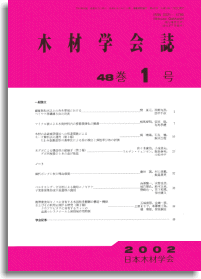
Mokuzai Gakkaishi, Journal of the Japan Wood Research Society, was divided into two bimonthly journals, Mokuzai Gakkaishi and Journal of Wood Science, from vol. 44 (1998). The new Mokuzai Gakkaishi publishes original reports in Japanese but with English abstracts, and the Journal of Wood Science those in English only.
The papers are carefully selected by an editorial board to cover all aspects of Biology of Tree and Related Microorganisms, Wood Anatomy and Structure, Wood Physics and Chemistry, Timber Engineering, and Environmental Material Science. |
 |
Instructions to Authors
-
Manuscripts for publication and all correspondence should be sent to: The Editorial Office of the Journal of Wood Science, c/o Wood Research Institute, Kyoto University, Uji 611-0011, Japan. Tel.: +81-774-38-3664; Fax.: +81-774-38-3664; E-mail: edit-office@jwrs.org
Prerequisites for publication: The first author must be a member of the Japan Wood Research Society; however, contributions from nonmembers from outside Japan are also acceptable. A copy of the certification form included in each issue must be submitted with the manuscript. The editorial board decides whether to accept or reject submitted manuscripts in consultation with at least two referees.
Types of articles: Articles may be in the form of Original articles, Notes, Rapid communications, or Review articles. The maximum length for each type of article is 6, 4, 2, and 8 printed pages, respectively.
Original articles are reports of original studies with new and valuable results. Notes are short reports of original studies of limited scope. Rapid communications are intended for rapid, preliminary publication of a significant discovery. The manuscript must be accompanied by a letter, in Japanese or in English, from the author stating reasons that would justify publication as a rapid communication. Review articles are reports of recent advances on the research of selected topics.
Manuscript form: Three complete copies of the manuscript, including tables and figures, must be supplied. The original manuscript should not be sent until authors have been notified of acceptance for publication. The abstract, text, references, tables, and figure legends must be typed double-space with wide margins on one side of good-quality A4 paper. A complete list of submitted materials must accompany each manuscript. Incomplete or improperly prepared manuscripts will be returned to the authors without review.
A separate title page should be provided. The abstract, text, acknowledgments, references, tables, legends, and figures should begin on separate sheets and follow in that order. Standard abbreviations and units should be used; SI units are recommended. Abbreviations should be defined at first appearance, and their use in the title and abstract should be avoided. Generic names of chemicals should be used. Genus and species names should be typed in italic or, if this is not available, underlined.
All manuscripts must be written in English. Authors who are not fluent in English must seek the assistance of a colleague who is a native English speaker and is familiar with the field of the work. Manuscripts that have been extensively modified in the editorial process will be returned to the authors for retyping.
Title page: Titles should be brief, specific, and informative. Include the type of article; the full names and affiliations of authors; address to which proofs are to be sent, including a fax number, telephone number, and e-mail address; and 3-5 key words or phrases for indexing.
Abstract: For Original articles, Notes, and Review articles, a concise description (not more than 200 words) of the purpose, methods, results, and conclusions is required. Give only the most essential data. New and important aspects of the research should be emphasized.
Text: For Original articles and Notes, the text of experimental articles should be, if possible, divided into the following sections: Introduction, Theory, Materials and methods (or Experimental), Results, and Discussion.
Symbols and equations: All symbols representing quantities will be set in italic unless otherwise indicated in the manuscript. Any special requirements for the appearance of symbols representing quantities and equations must be stated clearly in a note to the publisher. Any letters to be printed bold or in special fonts should be identified. Equation numbers should be flush right in parentheses.
References: Number references consecutively in the order cited in the text, not alphabetically. The accuracy of reference data is the authors' responsibility. Personal communications and unpublished data should not be included in the reference list but may be cited in parentheses in the text. If such a citation is from someone other than the authors, a letter should be submitted in which the direct quotation is given with the signature of its author. Unpublished papers accepted for publication may be included in the list by designating the journal followed by "in press" in parentheses. In the reference list, provide inclusive page numbers for all references and give the names of all authors (the use of "et al." in the reference list is unacceptable). Journal titles should be abbreviated according to The List of Serial Title Word Abbreviations published by the ISSN International Center. References should be cited using superscript numbers, e.g., "Ross et al.,1 Suzuki and Tanaka,2 and Harada3 show that ...." For papers written in Japanese, follow the style of example 2.
- Ross JR, DeGroot RC, Nelson WJ, Lebow PK (1997) The relationship between stress wave transmission characteristics and the compressive strength of biologically degraded wood. Forest Prod J 47(5):89-93
- Suzuki T, Tanaka J (1987) Engineering plastics from lignin (in Japanese). Mokuzai Gakkaishi 33:213-218
- Harada H (1965) Ultrastructure and organization of gymnosperm cell walls. In: C魌?WA Jr (ed) Cellular ultrastructure of woody plants. Syracuse University Press, Syracuse, pp 215-233
Tables: Should be numbered consecutively with Arabic numerals in the order cited in the text. Each table should be given a brief informative title and should appear on a separate sheet. Explain in footnotes all abbreviations used.
Figures: Should be used with discretion and are justified only if they clarify or reduce the text required. Information given in captions should not be repeated in the text. Previously published figures usually are not accepted.
All figures, whether photographs, graphs, or diagrams, should be cited in the text and numbered sequentially with Arabic numerals. Each figure should be submitted on a separate sheet and should be of publication quality without any retouches in the printing office. A brief descriptive legend should be provided for each figure; legends should be typed on a separate sheet and the appropriate position of figures should be indicated in the left margin of the manuscript. The figure number, name of the first author, and the top of the figure should be indicated lightly in soft pencil on the back of each figure. Each of the three manuscript copies should include a copy of each figure; three photographs (copies with high grade) must be supplied.
The figures should match the size of either the column width (8.6 cm) or the printing area (17.6 ?23.6 cm). Related figures should be grouped into a plate on one page (17.6 ?23.6 cm). If plates are submitted, the figure parts, e.g., a, b, c, ..., should appear on the artwork, and the figures must be mounted on regular bond paper, not on cardboard. The figures, including legends, should not exceed the printing area.
In photomicrographs, a bar should be used as a size reference, with the length of the bar indicated either in the figure legend or on the micrograph. A magnification factor given in the legend is not acceptable.
Color illustrations will be accepted; however, the author will be expected to make a contribution to the extra cost (?10,000 for the first color page and ?0,000 for each additional color page).
Line drawings: Should be good-quality glossy prints in the desired final size. The inscriptions should be clearly legible; letters (capitals) 2 mm high are recommended. If reduction is absolutely necessary, please state the alternative scale desired. Computer drawings are acceptable provided their quality is comparable to that of line drawings.
Halftone illustrations: Photomicrographs, photos, and shaded drawings should be well-contrasted photographic prints (not photocopies), trimmed at right angles and in the desired final size. Inscriptions should be about 3 mm high. If reduction is absolutely necessary, please state the alternative scale desired. The publisher reserves the right to reduce or enlarge illustrations.
Diskettes: The submission of diskettes is encouraged, but they should not be sent until the review process has been completed and authors have been notified of acceptance for publication. Authors are requested to follow the instructions printed in the journal for preparation of diskettes.
Fees: The authors of accepted papers, not including Review articles invited by the editorial board, are requested to pay part of the printing cost as follows:
The cost for Original articles, Notes, and Review articles up to 6, 4, and 8 printed pages, respectively, is ?0,000 per page, but additional pages cost ?0,000 per page. The cost for Rapid communications up to 2 printed pages is ?0,000 per page, but additional pages cost ?0,000 per page.
Offprints: Authors receive 25 complimentary offprints. Further offprints are available in lots of 100. To order these, fill out the form enclosed with the proofs.
Top
Prerequisites for Publication
Articles other than as stated below are accepted for exclusive publication in the Journal of Wood Science. By submitting a paper, authors guarantee that they have not submitted and will not submit a similar paper for publication elsewhere in any language. Articles accepted for publication become the property of the Japan Wood Research Society and must not be published elsewhere in the same form without the written consent of the Society.
Each person listed as an author or coauthor for a submitted report (not including Review articles) must meet all three of the following criteria. An author or coauthor must have:
- Conceived, planned, and performed the work leading to the report, or interpreted the evidence presented, or both.
- Written the report or reviewed successive versions and shared in their revisions.
- Approved the final version.
Meeting these criteria should provide each author with sufficient knowledge of and participation in the work that he or she can accept public responsibility for the report. The senior or corresponding author is requested to certify that all listed authors meet the above three criteria.
Certification Form -- to be submitted with the manuscript
Journal of Wood Science
Article type:(please check a box to indicate our article type) (_) Oridingal Article, (_) Note, (_) Rapid Communications, (_) Review Article
Manuscript title:
Authors' names:
I hereby certify that the authors of the above manuscript have all:
- Conceived, planned, and performed the work leading to the report, or interpreted the evidence presented, or both;
- Written the report or reviewed successive versions and shared in their revisions; and
- Approved the final version.
Further, I certify that:
- This work has neither been published in whole or in part elsewhere nor is under consideration elsewhere; and
- This paper has been carefully read by a native English speaker who is familiar with the field of the work. (This applies to authors who are not fluent in English.)
I hereby assign the copyright to this paper to the Japan Wood Research Society. (If the paper is rejected this assignment is null and void.)
Signature: _______________________________ Date: ___________________
Fees -- to be submitted with the manuscript
The authors of accepted papers, not including Review articles invited by the editorial board, are requested to pay part of the printing cost as follows: The cost for Original articles, Notes, and Review articles up to 6, 4, and 8 printed pages, respectively, is \10,000 per page, but additional pages cost \40,000 per page. The cost for Rapid communications up to 2 printed pages is \20,000 per page, but additional pages cost \50,000 per page.
Editorial Board
|







 刊名字顺( Alphabetical List of Journals):
 返回页首
返回页首 