期刊名称:LC GC NORTH AMERICA
 期刊简介(About the journal)
投稿须知(Instructions to Authors)
编辑部信息(Editorial Board) 期刊简介(About the journal)
投稿须知(Instructions to Authors)
编辑部信息(Editorial Board)
About the journal
|
LC*GC North America is devoted to chromatography and the separation sciences. LC*GC North America offers analytical scientists practical information, supplying accurate and reliable peer-reviewed articles. Regular columns include LC troubleshooting, GC connections, sample preparation perspectives, questions on quality, coupling matters and CE currents.
|
Instructions to Authors
Information For Authors
LCGC welcomes manuscripts that describe techniques and applications of all forms of chromatography and capillary electrophoresis and that are of immediate interest to users in industry, academia, and government. Send manuscripts to: David Walsh, LCGC North America,Woodbridge Corporate Plaza, 485 Route 1 South, Building F, First Floor, Iselin, NJ 08830, USA. Telephone: (732) 346-3082, fax: (732) 596-0003, e-mail: david.walsh@advanstar.com
To submit an article to LCGC Europe or LCGC Asia Pacific please contact the editor, Alsadair Matheson: amatheson@advanstar.com
To submit an article to The Column, LCGC en fran鏰is or LCGC Ausgabe in deutscher Sprache please contact the editor, Janet Kelsey: jkelsey@advanstar.com
Manuscripts are reviewed with the understanding that they have not been published previously and are not under consideration for publication elsewhere. Authors are responsible for all statements made in their work. All manuscripts are subject to peer review and copyediting. Authors of accepted papers will have an opportunity to review galleys. Upon acceptance, copyright of the manuscript is transferred to LCGC. If illustrations or other material in a manuscript have been published previously, the author is responsible for obtaining permission to republish. Rejected manuscripts are returned on request. LCGC is not responsible for loss of materials.
Papers accepted for publication in LCGC may be considered for publication in LCGC International, which is distributed mainly in Western Europe, and in LCGC Asia Pacific, which is distributed in Asia and Australia.
Editorial Focus
Because LCGC is directed to experienced researchers and applications personnel in the field of chromatography, avoid describing details or techniques that are common knowledge among such specialists.
Five types of articles are suitable for LCGC:
Feature articles survey current techniques or emerging technologies. Manuscripts should be 10-15 pages (2500-3750 words) long. We urge authors to submit a proposal to the editor before completing a manuscript.
Technical articles describe improved methods or improvements in techniques. Papers should be 5-10 pages (1250-2500 words) long and should be of immediate relevance to chromatography users. Manuscripts should be presented in an abbreviated scientific format and should include the following:
Abstract:
Very brief. Mention subjects studied, methods used, principal observations made, and conclusions reached.
Introduction:
Without repeating published information, discuss the relationship of your work to previously published work. Describe the novelty or importance of the research presented.
Experimental:
Present enough information that an experienced chromatographer would be able to reproduce the work. List those components of the experimental design that are of a specialized nature, including equipment manufacturers names and locations in parentheses after reference to specific types of equipment. Do not list equipment, reagents, or procedures that are normally found in the laboratory or that are common knowledge in the field. Include the following minimal information as it pertains to the particular type of chromatography being used: column dimensions, film thickness, packing type, mobile-phase composition, flow rate, detection method, injection conditions, instrument temperatures, applied potential, and instrument program.
Results and discussion:
Focus your comments on the needs of users of chromatography, stress the practical importance of your findings.
Conclusion:
Summarize the main points of your article, state important conclusions or recommendations.
Technical notes are brief descriptions of equipment modifications and designs that provide tips on improved efficiency in equipment use or advice on cutting costs. Manuscripts should be 1-4 pages (250-1000 words) long.
Back to Basics articles describe the historical background, current and potential applications, basic theory, instrumental setup, and advantages and limitations of a new or existing separations-related technique. Manuscripts should be 3-6 pages (750-1500 words) long.
Manuscript Preparation
For papers with multiple authors, designate a single author to handle correspondence. Include this authors full mailing address, telephone number, fax number, and e-mail address in the cover letter that accompanies the manuscript. Before submitting the completed work, authors are urged to review manuscripts for clarity of expression, details of grammar, and typographical accuracy. Send one original and two copies.
Manuscripts must be typewritten (double-spaced) with liberal margins and space at the top and bottom of the page. We encourage authors to submit manuscripts on computer diskette, contact the editor for information. Begin each of the following on a separate page: title page (with each authors name, affiliation, and title), abstract, the first page of the text, references, captions for illustrations, and tables. Titles should be short, specific, and clear. Beginning with the first page of text, number each page consecutively.
Illustrations
If illustrations or other material in a manuscript have been published previously, the author is responsible for obtaining permission to republish. Refer to photographs, line drawings, and graphs in the text using arabic numerals in consecutive order (Figure 1, Figure 2, etc.). Omit all illustrations that do not enhance the readers understanding of the text. Line drawings, graphs, and charts must be professionally rendered and submitted camera-ready as high-quality, glossy, photographic prints or clean ink drawings. Lines of chromatograms must be solid and heavy enough to remain legible after reduction. Provide peak labels and identification. Identify all illustrative material by the figure number and first authors name on the reverse side using a nonbleeding felt-tip pen. Provide figure captions on a separate page, each identified by its proper number and title.
Tables
Each table should be typed (double-spaced) on a separate sheet of paper, with the first authors name on the reverse side. Refer to tables in the text by roman numerals in consecutive order (Table I, Table II, etc.). Every table and each column must have an appropriate heading. Table number and title must be placed in a continuous heading above the data presented. Omit tables that contain information already included in the text.
References
Literature citations in the text must be indicated by arabic numerals in parentheses. Number each reference separately in the order in which it appears in the text. List cited references at the end of the manuscript in the order of their appearance in the text not alphabetically. Designate submitted articles as in press only if they are formally accepted for publication and give the future volume number and year, if possible. Use unpublished work otherwise, giving the date when the work was completed. For personal communications, include name and date.
Use the following format for references:
(1) T.L. Einmann and C. Champaign, Science 387, 922-930 (1981).
(2) E. Mitosouki and F.G. Pleinum, in Natural Cell-Mediated Immunity Against Infection, W.J. Kinman, Ed. (Plenum Press, New York, 1980), pp. 345-376.
Editorial Board
 |
John W. Dolan"LC Troubleshooting" Editor
john.dolan@lcresources.com
John Dolan has been writing "LC Troubleshooting" for LCGC for over 20 years. One of the industry's most respected professionals, John is currently the Vice President of BASi Northwest Laboratory, McMinnville, Oregon and a principal instructor for LC Resources, Walnut Creek, California. He is also a member Editorial Staff Contacts
North America Europe & Asia
Group Publisher
Michael J. Tessalone
mtessalone@advanstar.com Publisher
Andrew Davies
adavies@advanstar.com
Editor-in-Chief
David Walsh
dwalsh@advanstar.com Editorial Director
Peter Houston
phouston@advanstar.com
Group Technical Editor
Stephen A. Brown
sbrown@advanstar.com Editor (Print)
Alasdair Matheson
amatheson@advanstar.com
Managing Editor
Patrick Kempf
pkempf@advanstar.com Editor (Electronic)
Janet Kelsey
jkelsey@advanstar.com
Assistant Editor
Megan Evans
mevans@advanstar.com Associate Editor
Felicity Thomas
fthomas@advanstar.com
Art Director
Melissa Coscarelli Harrison
mcoscarelliharrison@advanstar.com
E-Media Director
Bill Levine
wlevine@advanstar.com
--------------------------------------------------------------------------------
Our Offices - Advanstar Communications, Inc.
--------------------------------------------------------------------------------
North America
485 Route 1 South
Building F, First Floor,
Iselin, NJ 08830
tel. (732) 596-0276
fax: (732) 225-0211
Europe
Advanstar House
Park West
Sealand Road
Chester
CH1 4RN
Tel: +44 (0) 1244 378 888
Fax: +44 (0) 1244 370 011
Asia Office
501 Cambridge House,
TaiKoo Place, 979 King's Road,
Quarry Bay, Hong Kong,
People's Republic of China
Tel. +852 (2559) 2772
Fax +852 (2559) 7002
|
|








 刊名字顺( Alphabetical List of Journals):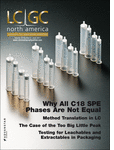
 返回页首
返回页首 