期刊名称:LASER PHYSICS
 期刊简介(About the journal)
投稿须知(Instructions to Authors)
编辑部信息(Editorial Board) 期刊简介(About the journal)
投稿须知(Instructions to Authors)
编辑部信息(Editorial Board)
About the journal
Laser Physics
Laser Physics is an international journal published in cooperation with institutes involved in laser research. The renowned Russian laser physicist and Nobel Prize winner, Academician Alexander M. Prokhorov, was the first Editor-in-Chief of the journal from its foundation in 1990 up to 2002. The journal offers a comprehensive view of theoretical and experimental laser research and applications by top authors. Articles cover every aspect of modern laser physics and quantum electronics, emphasizing physical effects in various media (solid, gaseous, liquid) leading to the generation of laser radiation; peculiarities of propagation of laser radiation; problems involving impact of laser radiation on various substances and the emerging physical effects, including coherent ones; the applied use of lasers and laser spectroscopy; the processing and storage of information; etc. (See the list of topics) An important part of the journal is devoted to reviews, supplemented by biographical briefs of authors. In addition to original papers and reviews, the journal contains proceeding of international conferences, symposia and seminars. This journal is a valuable resource for scholars and scientists, laboratories and libraries. The rapid publication, distribution, and delivery of Laser Physics assure recipients timely delivery of current news and research.
Laser Physics is abstracted or/and indexed in Current Contents, SciSearch, Research Alert, and INSPEC.
Instructions to Authors
Instruction for Manuscript Preparation
|
1. GENERAL |
|
|
|
1.1. |
Manuscripts should be submitted in English or Russian. An original and one copy of the manuscript are required. |
|
1.2. |
Manuscripts should be typed using a laser, jet, or dot-matrix printer or a typewriter. |
|
1.3. |
The first page of the manuscript should include the title of the paper; initials and the surnames of authors (even if the manuscript is submitted in Russian, the authors should indicate their initials and surnames in English); the mailing addresses of authors (even if the manuscript is submitted in Russian, the authors should indicate their addresses in English); e-mail address of the corresponding author; abstract of the paper; and the topic from the above list to which, in the authors?opinion, the paper can be assigned. The main text of the paper should begin on the second page of the manuscript. The text of the paper should be completed with the References section. The manuscript should also include table, figure, and photograph captions and tables, figures, and photographs. All pages in the manuscript should be consecutively numbered (including tables, figures, and figure and table captions). A separate sheet at the end of the manuscript should contain the following information about the corresponding author: initials and surname, office and home telephone numbers, fax number, and e-mail address (mandatory). |
|
1.4. |
In certain cases, the Editorial Board promptly publishes letters to the Editor. The length of a letter to the Editor should not exceed 10 pages, including the abstract, the text of the manuscript, the list of references, figures, photographs, tables, and table and figure captions. |
|
1.5. |
The Editorial Board considers the submission of a manuscript and an official application to publish this manuscript in the Laser Physics journal as intent of the authors to transfer the copyright for a single publication of this paper in the Laser Physics journal. |
|
|
|
2. PUBLICATION STAGES |
|
|
|
2.1. |
Upon receipt of a manuscript, the Editorial Board informs the authors using e-mail. |
|
2.2. |
Upon receipt of a manuscript from a reviewer, the Editorial Board informs the authors about the time of publishing of the manuscript using e-mail. |
|
2.3. |
Normally, a notice of page proofs will be sent to the corresponding author one week before proofreading. Page proofs will be sent to the corresponding author by e-mail in the pdf format. Please note that corrections should be restricted to typographical errors. Please send these corrections to our Staff Editor Mrs. Ekaterina A. Vlasova by e-mail k_vlasova@mail.ru in three days. If corrections are not received by this deadline, the proofreading will be done by the Technical Editor in accordance with the original version of the manuscript. |
|
2.4. |
The offprints will be sent to the corresponding author by e-mail in the pdf format. |
|
|
|
3. GENERAL REQUIREMENTS FOR PREPARING MANUSCRIPTS |
|
|
|
3.1. |
Formulas should be numbered in the order of their appearance throughout the manuscript. Formulas are labeled with Arabic numbers in parentheses on the right. |
|
3.2. |
Footnotes should be numbered in the order of their appearance throughout the manuscript. |
|
3.3. |
The literature cited should be formatted as a single list at the end of the manuscript rather than as footnotes (references should be given in English even if the authors submit a manuscript in Russian). Within the text, references should appear as consecutive numbers in square brackets (e.g., [1]). The list of references should be given in the order of the first appearance of references in the text. The list of references should be formatted as follows. |
|
|
|
3.3.1. |
For articles in journals, indicate the surnames and initials of the authors, the year, the title of the journal, the volume number, and the number of the first page of the reference, for example,
1. Smith, A.M., Hant, G., and Fenton, I., 1990, Laser Phys., 1, 123. |
|
|
|
|
3.3.2. |
For books, indicate the surnames and initials of the authors, the year, the full title of the book, and the city and the publisher (in parentheses), for example,
2. Polyakova, S.S., Morgan, S., and Charlton, P., 1990, Quantum Mechanics (New York: Allen).
In references, if the number of authors of the cited article or book is less than or equal to four, then cite the names of all the authors. If the number of authors is greater than four, then cite only the first three authors and use et al. in place of the names of the other authors. |
|
|
3.4. |
All figures and drawings should be legible and should be prepared in a format that ensures a clear understanding of all the details. This is especially important for photographs. Drawings should be presented separately from the text of the manuscript. Never paste drawings onto the original. All the figures should be properly captioned. Figure captions should be typed on a separate numbered sheet. The surname of the first author, the title of the paper, and the figure number should be indicated on the face side of figures and drawings at the bottom of the sheet in its free area. Wherever possible, replace lettering in figures by numbers or symbols, which should be identified in figure captions or within the text. If it is impossible to replace lettering by numbers or symbols, provide lettering in English (even for articles submitted in Russian). Black-and-white photographs should be glossy and free of defects. Each photograph should be identified on the back by the surname of the first author, the title of the paper, and the number of the photograph written in a soft black pencil. Use a black pencil to indicate places within the text where figures, tables, and photographs should be positioned. |
|
3.5. |
In manuscripts submitted in Russian, provide English spelling of proper names in parentheses as these names appear for the first time in the text (except for names of common knowledge, e.g., names that can be found in an encyclopedia, and names that are cited in the list of references); if authors use special uncommon terminology, then it is recommended to provide an English translation for such terms on a separate sheet. |
|
3.6. |
The authors of review articles requested by the Editorial Board should enclose glossy black-and-white 6*9-cm photographs of each of the authors and brief biographies of each of the authors. |
|
|
|
4. PREPARING MANUSCRIPTS USING LASER OR JET PRINTERS |
|
|
|
4.1. |
All mathematical expressions should be carefully written and checked, so that the compositor can easily follow the copy. Vectors and matrices are set in special type style and must be identified for the compositor. Authors are requested to provide a list of vectors and matrices appearing in their manuscripts or to explain in the margin any symbols that they have used to identify those vectors and matrices. All letters and numbers whose identity might be unclear should be identified in the margin. When Greek letters are handwritten, they should be spelled out when they first appear. |
|
|
|
5. PREPARING MANUSCRIPTS USING A DOT-MATRIX PRINTER |
|
|
|
5.1. |
Requirements for mathematical expressions are given in Section 4.1. |
|
5.2. |
If the manuscript is submitted in English, it is desirable to provide a diskette with the text of the manuscript in ASCII codes. |
|
5.3. |
Do not use a dot-matrix printer for producing figures and drawings. If a dot-matrix printer is used, figures and drawings should be redrawn in order to exclude distortion of the information due to dot structures characteristic of dot-matrix printers. |
|
|
|
6. PREPARING MANUSCRIPTS USING A TYPEWRITER |
|
|
|
6.1. |
A manuscript in English or Russian should be typed double-spaced on one side of the page with the left margin no less than 3.5 cm. At the beginning of the manuscript, the title of the paper is typed in English or Russian. Below, type the initials, surnames, and mailing addresses of authors in English (even for manuscripts submitted in Russian). |
|
6.2. |
Formulas should be legible, properly spaced, and appropriately large. In writing formulas, use India or black ink. Special attention should be given to careful writing of indices and exponents: subscripts should never be written on the same level as main symbols, a prime should be distinguishable from unity, and unity should be distinguishable from comma. Wherever possible, avoid cumbersome notations and simplify composition of formulas [e.g., replacing ex by exp(x) and using ab-1 or a/b ]. |
|
6.3. |
To avoid errors during composition, in writing formulas, clearly differentiate between upper- and lower-case characters. In those cases when upper- and lower-case characters have similar outlines and differ only by their sizes (V and v, U and u, W and w, O and o, K and k, S and s, P and p), upper-case characters should be doubly underlined in a black pencil, whereas lower-case characters should be marked with two dashes above the character . One should clearly differentiate between the letters e and l and the numeral 1 (e should be written as e, and l should be written as l). One should also clearly differentiate between upper-case O, lower-case o, and 0 (zero). For this purpose, mark O and o with two dashes using a black pencil and do not underline zero. Finally, one should differentiate between I and J. For this purpose, write in the manuscript I as a Roman unity. |
|
6.4. |
Use a red pencil to underline Greek letters with a straight line. Use a blue pencil to underline vectors with a wavy line. |
|
6.5. |
Use a blue pencil to underline scalar characters typed within the text with a straight line. |
|
6.6. |
Handwritten and gothic symbols should be defined in the margin when they first appear in the text. |
|
6.7. |
Indices and exponents should be indicated using a black pencil. Subscripts (e.g., in I2) should be indicated as I2, whereas superscripts and exponents (e.g., in I2) should be indicated as I2. Use this system for identifying characters and symbols both in the original and in the copy. |
|
|
|
7. INSTRUCTIONS FOR ELECTRONIC SUBMISSION |
|
|
|
7.1. |
Manuscripts written in English may be submitted by e-mail. To submit your paper electronically, please prepare a file with the text of the paper and files with figures, saving each figure in a separate file. The size of each file should not exceed 1 MB. |
|
7.2. |
When sending your manuscripts by e-mail, please specify the title of the journal (Laser Physics) in the SUBJECT field and the name of the first author. Send your files in the attachment. Please compress your files, if necessary, only using ARJ, ZIP, RAR and the like. Please save your files with figures under names giving an idea of the paper they belong to and the figure number (e.g., LasPhys - Smith - Fig. 3a) |
|
7.3. |
MS Word for Windows is a preferable format for the main text of the paper. Please use standard Windows TrueType fonts (e.g., Times New Roman, Courier New, Arial) and 12 font size. |
|
7.4. |
Graphic files can be prepared in the TIF format, 600 dpi, 256 gray-scale levels. Please send vector graphics in the original format, not as objects pasted in some other file CorelDraw (up to 8.0). Adobe Illustrator (up to 8.0), FreeHand (up to 8.0), or in the EPS format. Please use the TIF format for photos (no less than 300 dpi). |
|
|
|
8. PROOFREADING |
|
|
|
8.1. |
Page proofs will be sent to the corresponding author by e-mail in the pdf format. To read them, you will need Adobe Acrobat Reader 2.1 or higher. The necessary software can be downloaded at
http://www.adobe.com/prodindex/acrobat/readstep.html |
|
8.2. |
Corrections should be restricted to typographical errors. |
|
8.3. |
Please send your corrections as a plain text file, containing the following information (1) Paper Title; (2) List of all the authors; (3) List of corrections In the list of corrections, please specify Page number; Column number: Paragraph (figure or formula) number; Line number from the top or from the bottom of the paragraph; Please format your changes according to the following pattern: CORRECT "..." INSTEAD OF "...". |
|
8.4. |
Please send your corrections in three days to Mrs. Ekaterina A. Vlasova, Staff Editor, by e-mail
k_vlasova@mail.ru.
The e-mail address of the Editorial Board is yevseyev@theor.mephi.ru. |
The e-mail address of the Editorial Board is yevseyev@theor.mephi.ru.
Sending of Manuscripts
An original and one copy of the manuscript should be mailed or may be sent by Express Mail to the following address:
Prof. Igor V. Yevseyev
Department of Theoretical Physics, Moscow State Engineering Physics Institute,
31 Kashirskoe Shosse, Moscow, 115409, Russia
Manuscripts written in English may be submitted electronically. (In this case a hard copy of the manuscript along with a covering letter should be also sent by ordinary mail to Prof. Igor V. Yevseyev (see the mail address above). Please send the text of the manuscript (without figures) by e-mail to comedt@maik.ru and the figures to cedgraph@maik.ru.
The e-mail address of the Editorial Board is: yevseyev@theor.mephi.ru.
Editorial Board
Editor-In-Chief
 |
Pavel P. Pashinin
Prokhorov General Physics Institute, Moscow, Russia
pashinin@rfbr.ru |
|
 |
Deputy Editor-In-Chief
Editorial Office |
Moscow State Engineering Physics Institute, 31 Kashirskoe Shosse, Moscow, 115409, Russia
Tel./fax: +7 (095) 148-2780, e-mail: yevseyev@theor.mephi.ru
Senior Translator for articles received in Russian:
Staff Editor:
|
Editorial Board |
|
|
 |
Zhores I. Alferov
Ioffe Physico-Technical Institute, St. Petersburg, Russia
zhores.alferov@pop.ioffe.rssi.ru |
|
 |
Sergey N. Bagayev
Institute of Laser Physics, Novosibirsk, Russia
bagayev@ilph.nsk.su |
 |
 |
Vanderlei S. Bagnato
University of Sao Paulo, Sao Carlos, Brazil
vander@ifqsc.sc.usp.br |
 |
 |
Zhou Bingkun
Tsinghua University, Beijing, China
zbk-dee@mail.tsinghua.edu.cn |
 |
 |
See Leang Chin
Laval University, Quebec, Canada
slchin@phy.ulaval.ca |
 |
 |
Steven Chu
Stanford University, Stanford, USA
schu@stanford.edu |
| |
 |
Alexander M. Dykhne
Kurchatov Institute of Atomic Energy, Moscow, Russia
sasha_dykhne@hotmail.com |
| |
 |
Joseph H. Eberly
University of Rochester, Rochester, USA
eberly@pas.rochester.edu |
| |
 |
Mikhail V. Fedorov
Prokhorov General Physics Institute, Moscow, Russia
mikhail-fedorov@mtu-net.ru |
 |
 |
Gaetano Ferrante
Palermo University, Palermo, Italy
ferrante@cuc.unipa.it |
 |
 |
Costas Fotakis
Foundation for Research and Technology - Hellas, Heraklion, Crete, Greece
fotakis@iesl.forth.gr |
| |
 |
Sergey A. Gonchukov
Moscow State Engineering Physics Institute, Moscow, Russia
gonchukov@mephi.ru |
| |
 |
John L. Hall
University of Colorado, Boulder, USA
jhall@jila.colorado.edu |
| |
 |
Sven R. Hartmann
Columbia University, New York, USA
srh@phys.columbia.edu |
 |
 |
Norbert Kroo
Central Research Institute for Physics, Budapest, Hungary
kroo@power.szfki.kfki.hu |
| |
 |
Jamal T. Manassah
The City University of New York, New York, USA
manassah@ccny.cuny.edu |
|
 |
Gennady A. Mesyats
Vice-President of the Russian Academy of Sciences, Moscow, Russia
mesyats@pran.ru |
| |
 |
Gerard A. Mourou
University of Michigan, Ann Arbor, USA
mourou@umich.edu |
| |
 |
Kirill A. Prokhorov
Prokhorov General Physics Institute, Moscow, Russia
cyrpro@gpi.ru |
 |
 |
Peeter M. Saari
Tartu Institute of Physics, Tartu, Estonia
psaari@fi.tartu.ee |
|
 |
Vitaly V. Samartsev
Institute of Technical Physics, Kazan, Russia
samartsev@dionis.kfti.kcn.ru |
 |
 |
Wolfgang Sandner
Max Born Institute for Nonlinear Optics and Short Pulse Spectroscopy, Berlin, Germany
sandner@mbi-berlin.de |
| |
 |
Igor I. Sobel'man
Lebedev Physical Institute, Moscow, Russia
mira@sci.lpi.ac.ru |
| |
 |
Herbert Walther
Max-Planck Institute of Quantum Optics, Garching, Germany
herbert.walther@mpq.mpg.de |
 |
 |
Douwe A. Wiersma
University of Groningen, Groningen, The Netherlands
wiersma@chem.rug.nl |
 |
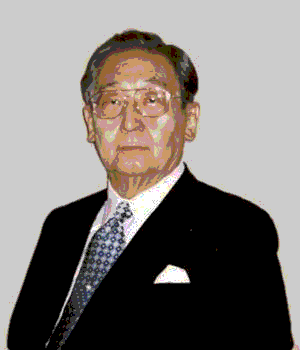 |
Chiyoe Yamanaka
Institute for Laser Technology, Osaka, Japan
yamanaka@ile.osaka-u.ac.jp |
| |
 |
Valery M. Yermachenko
Moscow State Engineering Physics Institute, Moscow, Russia
yermachenko@yandex.ru |
|
 |
Vyacheslav I. Yukalov
Joint Institute for Nuclear Research, Dubna, Russia
yukalov@thsun1.jinr.ru |
|
 |
Aleksey M. Zheltikov
Moscow State University, Moscow, Russia
zheltikov@top.phys.msu.su | |
|










 刊名字顺( Alphabetical List of Journals):

 返回页首
返回页首 