期刊名称:CLINICAL AND APPLIED THROMBOSIS-HEMOSTASIS
 期刊简介(About the journal)
投稿须知(Instructions to Authors)
编辑部信息(Editorial Board) 期刊简介(About the journal)
投稿须知(Instructions to Authors)
编辑部信息(Editorial Board)
About the journal
Clinical and Applied Thrombosis/Hernostasis is dedicated to serving as a reporting forum for studies regarding the etiology, pathophysiology, clinical diagnosis, laboratory diagnosis, and treatment of thrombohemorrhagic disorders. Articles dealing with new diagnostic procedures are encouraged, provided they are clinically oriented or potentially applicable to clinical and laboratory medicine. Articles dealing with all aspects of thrombosis, hemostasis, and thrombolysis of clinical or clinical laboratory applicability are also encouraged. The contents of the journal are of appeal to any person interested in clinical and applied thrombohemorrhagic disorders.
Instructions to Authors
Abbreviations: For a list of standard abbreviations, consult the Council of Biology Editors Style Guide (available from the Council of Science Editors, 9650 Rockville Pike, Bethesda, MD 20814) or other standard sources. Write out the full term for each abbreviation at its first use unless it is a standard unit of measure.
Manuscript Submission
Manuscripts should be sent to:
Rodger L. Bick, MD, PhD, FACP, University of Texas Southwestern Medical Center
10455 North Central Expressway, Suite 109, PMB 320
Dallas TX 75231
Telephone: (214) 373-9350; Fax: (214) 373-9351.
Email: rbick@thrombosis.com
Preparation of Manuscript
Manuscripts that do not adhere to the following instructions may be returned to the corresponding author for technical revision.
General format: Submit manuscripts in English in triplicate (one original and two copies) and printed on standard 81/2 x 11-inch (21 x 28-cm) paper with at least a I-inch (2.5 cm) margin on all sides. Double space all copy, including legends, footnotes, tables, and references, and print on one side of the sheet only. In addition to the paper version, the manuscript must be submitted electronically either on disk or as an e-mail attachment. Electronic files should be submitted in a standard word processing format; Microsoft Word (or Corel WordPerfect) is preferred. Although conversions can be made from other word processing formats, the vagaries of the conversion process may introduce errors. Do not submit ASCII text files. Do not use automatic numbering or footnotes for references. Each submitted disk must be clearly labeled with the name of the author, item title, journal title, word processing program and version, and file name used. The disk should contain only one file-the final version of the manuscript.
Title page: Include on the title page (a) complete manuscript title; (b) authors'full names, highest academic degrees, and affiliations; (c) name and address for correspondence, including fax number, telephone number, and e-mail address; (d) address for reprints if different from that of corresponding author; and (e) sources of support that require acknowledgment, and a short title of no more than 45 characters (including spaces) for use as a running head.
Unstructured abstract and key words: Limit the summary to 250 words. it must be factual and comprehensive. Limit the use of abbreviations and acronyms, and avoid general statements (eg, "the significance of the results is discussed"). List three to five key words or phrases.
Text: Organize the manuscript into j ournal- specific main headings. Define abbreviations at first mention in text and in each table and figure. If a brand name is cited, supply the manufacturer's name and address (city and state/country). Acknowledge all forms of support, including pharmaceutical and industry support, in an Acknowledgments paragraph.
References: The authors are responsible for the accuracy of the references. Key the references (double-spaced) at the end of the manuscript. Cite the references in text in the order of appearance. Cite unpublished data, such as papers submitted but not yet accepted for publication or personal communications, in parentheses in the text. If there are more than three authors, name only the first three authors and then use et al. Refer to the List of Journals Indexed in Index Medicus for abbreviations of journal names, or access the list at http://www.nlm.nih.gov/tsd/serials/Iji.html. Sample references are given below:
Journal article
1. Glidden PF, Malaska C, Herring SW. Thromboelastograph assay for measuring the mechanical strength of fibrin sealant clots. Clin Appl ThrombosislHemostasis 2000;6:226.
Book chapter
2. Todd VR. Visual information analysis: frame of reference for visual perception. In: Kramer P, Hinojosa J, eds. Frames of Reference for Pediatric Occupational Therapy. Philadelphia: Lippincott Williams & Wilkins, 1999;205.
Entire book
3. Katz AM. Heart Failure. Philadelphia: Lippincott Williams & Wilkins, 1999.
Software
4. Epi Info [computer program]. Version 6. Atlanta: Centers for
Disease Control and Prevention; 1994.
Online journals
5. Friedman SA. Preeclampsia: a review of the role of prostaglandins. Obstet Gynecol [serial online]. January 1988;71 :22-37. Available from: BRS Information Technologies, McLean, VA. Accessed December 15, 1990.
Database
6. CANCERNET-PDQ [database online]. Bethesda, MD: National Cancer Institute; 1996. Updated March 29, 1996.
World Wide Web
7. Gostin LO. Drug use and HIV/AIDS (JAMA HIV/AIDS web site). June 1, 1996. Available at: http://www.amaassn.org/ special/hiv/ethics. Accessed June 26, 1997.
URL (uniform resource locator)
8. (J. M. Kramer, K. Kramer [jmkramer@umich.edu], e-mail, March 6, 1996).
Figures: Cite figures consecutively in the text, and number them in the order in which they are discussed. Write the first author's last name, the figure number and figure part (1A, 113, 1Q, and an arrow to indicate the top edge of the figure on a label pasted to the back of each figure. Submit all artwork in triplicate in camera-ready form; illustrations should be glossy prints or high-quality, laser-printed illustrations. Photocopies are unacceptable. Lettering should be large enough that it will remain legible after figure reduction; typewritten or unprofessional lettering is unacceptable. Figure parts (A, B, Q may be left unlabeled (but clearly marked on back) for professional placement by the journal's printer.
Figure legends: Legends must be submitted for all figures. They should be brief and specific, and they should appear on a separate manuscript page after the references. Use scale markers in the image for electron micrographs, and indicate the type of stain used.
Color figures: The journal accepts for publication color figures that will enhance an article. Authors who submit color figures will receive an estimate of the cost for color reproduction. If they decide not to pay for color reproduction, they can request that the figures be converted to black and white at no charge.
Digital figures: Electronic art may be submitted as TIFF (Tagged Image File Format) or EPS (Encapsulated Postscript) files and must be accompanied by a high-quality print. Preferred formats are Adobe Photoshop and Adobe Illustrator. Each figure must be contained in an individual file on a high-density floppy disk, Iomega Zip, CD-R, or email attachment. Always indicate the software used to create the art (eg, Photoshop 5.0, Illustrator 7.0). When considering the submission of electronic art, please request a copy of the Instructions for Preparing Electronic Art from the Journal's editorial office. PowerPoint, Corel Draw, and files downloaded from the Internet cannot be used.
Tables: Cite tables consecutively in the text and number them in that order. Key each on a separate sheet, and include the table title, appropriate column heads, and explanatory legends (including definitions of any abbreviations used). Do not embed tables within the body of the manuscript. They should be self-explanatory and should supplement, rather than duplicate, the material in the text.
Patient anonymity and informed consent: It is the author's responsibility to ensure that a patient's anonymity be carefully protected and to verify that any experimental investigation with human subjects reported in the manuscript was performed with informed consent and following all the guidelines for experimental investigation with human subjects required by the institution(s) with which all the authors are affiliated. Authors should mask patients' eyes and remove patients' names from figures unless they obtain written consent from the patients and submit written consent with the manuscript.
Copyright: All authors must sign a copy of the Journal's "Authorship Responsibility, Financial Disclosure, and Copyright Transfer" form. Send the signed form to Journal Production Editor, Clinical and Applied Thrombosis/Hemostasis, Westminster Publications, Inc, 708 Glen Cove Avenue, Glen Head, NY 11545.
Permissions: Authors must submit written permission copyright owner (usually the publisher) to use direct quotations, tables, or illustrations that have appeared in copyrighted form elsewhere, along with complete details about the source.
Style: Pattern manuscript style after the American Medical Association Manual of Style (9th edition). Stedman's Medical Dictionary (27th edition) and Merriam Webster's Collegiate Dictionary (10th edition) should be used as standard references. Refer to drugs and therapeutic agents by their accepted generic or chemical names, and do not abbreviate them. Use code numbers only when a generic name is not yet available. In that case, supply the chemical name and a figure giving the chemical structure of the drug. Capitalize the trade names of drugs and place them in parentheses after the generic names. To comply with trademark law, include the name and location (city and state in USA; city and country outside USA) of the manufacturer of any drug, supply, or equipment mentioned in the manuscript. Use the metric system to express units of measure and degrees Celsius to express temperatures, and use Sl units rather than conventional units.
After Acceptance
Page proofs and corrections: Corresponding authors will receive page proofs to check the copyedited and typeset article before publication. It is the author's responsibility to ensure that there are no errors in the proofs. Changes that have been made to make the article conform to journal style should be allowed to stand if they do not alter the authors' meaning. Authors may be charged for alterations to the proofs beyond those required to correct errors or to answer queries. Proofs must be checked carefully and returned within 24 to 48 hours of receipt, as requested in the cover letter accompanying the page proofs.
Reprints: Authors will receive a reprint order form with the page proofs that includes reprint costs. Reprint requests should be returned with the corrected proofs, if possible. Reprints are normally shipped 6 to 8 weeks after publication of the issue in which the item appears. Contact the Reprint Department, Westminster Publications, Inc, 708 Glen Cove Avenue, Glen Head, NY 11545, with any questions.
Publisher's contact: Send corrected page proofs, reprint order forms, color proofs, and any other related materials to Pulications Manager, Clinical and Applied ThrombosislHemostasis, Westminster Publications, Inc, 708 Glen Cove Avenue, Glen Head, NY 11545.
Manuscript Checklist
Three copies of complete manuscript
Three sets of clearly labeled figures
Copyright transfer form signed by all authors
Cover letter
Title page
Abstract
References double-spaced in AMA style
Corresponding author designated (in cover letter and on title page)
Permission to reproduce copyrighted materials or signed patient consent forms
Acknowledgments listed for grants and technical support
Materials packed in extra-strength envelope
Manuscript Authorship Responsibility, Assignment of Copyright, and Financial Disclosure form signed by each author
Disk and high-quality print of electronic art
Disk containing first version of manuscript and labeled with word processing program used
Editorial Board
|
EDITOR-IN-CHIEF
RODGER L. BICK, MD, PhD, FACP
Clinical Professor of Medicine and Pathology
University of Texas Southwestern Medical Center
Dallas, TX 75231, USA
SENIOR EDITORS
WILLIAM F. BAKER
Bakersfeild, CA
EUGENE P. FRENKEL
Dallas, TX
DEBORAH HOPPENSTEADT
Maywood, IL
RUSSELL HULL
Calgary, Canada
EBERHARD F. MAMMEN
Detroit, MI
GRAHAM PINEO
Calgary, Canada
SENIOR EUROPEAN EDITORS
KLAUS BREDDIN
Frankfurt,Germany
ANTIONO GIROLAMI
Padua, Italy
SYVILIA HAAS
Munich, Germany
MEYER SAMAMA
Paris, France
EDITORIAL BOARD
RAUL ALTMAN
Buenos Aires, Argentina
FREDERICK BALLANTYNE
St. Vincent's and the Grenadines
SAMUEL BERKMAN
Beverly Hills, CA
SERGIO COCCHERI
Bologna, Italy
JAWED FAREED
Maywood, IL
STEPHEN FREDD
Bethesda, MD
RICHARD HART
Diagnostics Industry
Greenwhich, CT
LOTHAR HEILMAN
Ruselsheim, Germany
JOSEPH F. HEISSLER, JR
Pharmaceutical Industry
Kalamazoo, MI
BRIGITTE KAISER
Erfurt, Germany
SVETLANA KAPLAN
Seattle, WA
|
MICHEAL LASSEN
Horsholm, Denmark
RAY LEE
Internal Medicine Editor
Dallas, TX
TAMOTSU MATSUDA
Kanazawa, Japan
HARRY MESSMORE
Book Review Editor
Maywood, IL
GENE MYERS
Cardiology Editor
Sarasota, FL
DIMITRI MIKHAILIDIS
London, England
MICHAEL MOSESSON
Milwaukee, WI
GENESIO MURANO
Bethesda, MD
BALI NETAJI
Austin, TX
ANDREW NICOLAIDES
Cypress
ROQUE PIFFARE
Cardiac Surgery Editor
Maywood, IL
LEON POLLER
London, UK
ALICE RUNGE
Santa Monica, CA
MERVYN SAHUD
Oakland, CA
ARTHUR SASAHARA
Boston, MA
AKIKAZU TAKADA
Shizouka-ken, Japan
ALI TOOFANIAN
Obstetrics/Gynecology Editor
Dallas, TX
ORAN ULUTIN
Istanbul, Turkey
Hal D. UNWIN
Neurology Editor
Dallas, TX
GEORG-FRIEDRICH VON TEMPELHOFF
Russelsheim, Germany
HIDEO WADA
Mie, Japan
WILLIAM WEHRMACHER
Book Review Editor
Maywood, IL |
|










 刊名字顺( Alphabetical List of Journals):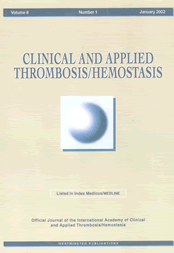
 返回页首
返回页首 