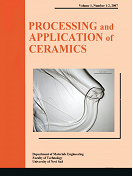
期刊名称:PROCESSING AND APPLICATION OF CERAMICS
 期刊简介(About the journal)
投稿须知(Instructions to Authors)
编辑部信息(Editorial Board) 期刊简介(About the journal)
投稿须知(Instructions to Authors)
编辑部信息(Editorial Board)
About the journal
Aim and scope
Processing and Application of Ceramics is an international open access journal publishing short communications, full-length research papers and reviews related to science and technology of ceramics. The Journal publishes experimental and theoretical research on the processing, structural characterization, functional characterization and applications of ceramics. Papers may cover any of the branches of ceramic materials in the field of advanced ceramics, ceramic composites, traditional ceramics and culture heritage. Processing and Application of Ceramics will also publish important initial results of ongoing research which should be referred to in more extensive papers being submitted elsewhere at a later date.
No publication fees
Publication in the Journal is free for all authors and there are no article processing charges.
Bibliographic & ordering Information
ISSN: 1820-6131 (Print version)
ISSN: 2406-1034 (Online version)
Imprint: Faculty of Technology, University of Novi Sad
Commenced publication: 2007
Indexing and Abstracting: SCI Expanded, SCOPUS, DOAJ
Audience
Materials scientists, ceramists
Open access statement
This is an open access journal which means that all content is freely available without charge to the user or his/her institution. Users are allowed to read, download, copy, distribute, print, search, or link to the full texts of the articles in this journal without asking prior permission from the publisher or the author. This is in accordance with the BOAI definition of open access.
Self-archiving Policy
Processing and Application of Ceramics endorses self-archiving of the final published version (Publisher's version/PDF) of the article, not just peer-reviewed final drafts. Author's Pre-print, Author's Post-print (accepted version) and Publisher's version/PDF may be used on author's personal website and departmental website, or deposited in an institutional repository and non-commercial subject-based repositories, such as PubMed Central, Europe PMC or arXiv, any time after publication. Publisher copyright and source must be acknowledged for deposit of Author's Post-print (accepted version) or Publisher's version/PDF and a link must be made to article's DOI.
Licensing

All papers published in Processing and Application of Ceramics are licensed under a
Creative Commons Attribution-NonCommercial-NoDerivatives 4.0 International License.
Instructions to Authors
Guide for Authors
Publication ethics
Before submission, all authors should refer to the journal's Publication Ethics and Publication Malpractice Statement. More information could be found elsewhere (Committee on Publication Ethics - COPE).
Submission of papers
On-line: Manuscripts should be submitted via PAC on-line submission system. Manuscript should be uploaded as a single file (pdf, doc, docx) with Tables and Figures included at the appropriate place in the text along with their captions (See Preparation of Manuscripts below). Cover letter and all other supplementary files should be submitted at the end of submission process as separate files.
E-mail: For the time being, it is still possible to submit manuscript via e-mail. Manuscripts in an electronic (PDF) version accompanied by a cover letter should be sent to the corresponding e-mail addresses:
pac@tf.uns.ac.rs or srdicvv@uns.ac.rs
Types of Contribution
• Original full-length research papers
• Short communications
• Review articles
Corresponding author
Clearly indicate who is responsible for correspondence at all stages of refereeing and publication, including post-publication. Ensure that telephone and fax numbers (with country and area code) are provided in addition to the e-mail address and the complete postal address. Full postal addresses must be given for all co-authors.
Preparation of Manuscripts
Manuscripts should be written in English in a clear and concise manner, with the following structure: Title, Authors, Affiliations, Abstract, Keywords, Main text, Acknowledgements, References, Figure Captions and then Tables and Figures. Use numbered headings for the following sections: Introduction, Experimental, Results, Discussion and Conclusions. Use 11 or 12 pt font size and standard fonts, double spacing and wide (3 cm) margins (avoid full justification, i.e., do not use a constant right-hand margin). Ensure that each new paragraph is clearly indicated. Short communications should be kept to a maximum of four typewritten pages. A short communication should be a brief but complete description of an investigation.
Title
Papers should be headed by a concise and informative title. This should be followed by the name(s) of the author(s) and by the name and complete address of the laboratory in which the work was performed.
Abstract
An abstract of 50-200 words should be included at the beginning of a paper. The abstract should comprise a brief and factual account of the contents and conclusions of the paper as well as an indication of any new information presented and its relevance. Abstracts should be understandable in isolation, and reference to formulae, equations or references that appear in the main text is thus not permissible.
Keywords
Immediately after the abstract, provide a maximum of five keywords. Click here for a complete list of keywords (one keyword can be selected free by your self - not from the list)
Units
The SI system should be used for all scientific and laboratory data. If, in certain instances, it is necessary to quote other units, these should be added in parentheses.
References
The references should be brought together at the end of the article, and numbered in the order of their appearance in the text. Numerals for references are given in square brackets. In the reference list, journals [1], books [2], edited multi-author books [3] and patents [4] should be cited in accordance with the following examples:
1. J. Dusza, J. Kovalcik, P. Hvizdoš, P. Šajgalik, M. Hnatko, M.J. Reece, “Enhanced creep resistant silicon-
nitride-based nanocomposite”, J. Am. Ceram. Soc., 88 [6] (2005) 1500-1503.
2. M. Winterer, Nanocrystalline Ceramics - Synthesis and Structure, Springer, Berlin 2002.
3. M. Zarzecka, M.M. Bucko, J. Brzezinska-Miecznik, K. Haberko, “YAG powder synthesis by the modified
citrate process”, pp. 35-39 in Proceedings of the Sixth Students Meeting – SM 2005, eds. by V.V. Srdic, J.
Ranogajec, Faculty of Technology, University of Novi Sad, Serbia, 2005.
4. A. Hashimoto, Y. Takase, “Method of manufacturing ceramic thick-film printed circuit board”. US patent 6 753
033 (June, 2004).
Tables
Tables should be typed in double spacing on separate sheets and provided with a suitable heading. Tables should be clearly referred to in the text using Arabic numerals. Considerable thought should be given to layout so that the significance of the results can be easily grasped. Each table should have a caption, which makes the general meaning understandable without reference to the text.
Illustrations
Figures should be of a reproducible quality and roughly the same size. All Figures should have clear and concise captions. Lettering should be consistent and no smaller than size 12 (Helvetica preferred). The type and symbol size should be in proportion to the size of the figure. When scale is important to interpretation of objects in a photograph, a legible scale marker must be included.
• Drawings made with Adobe Illustrator and CorelDraw generally give good results, use Times New Roman font.
• For halftones and halftone/line art combinations, the minimum resolutions are 300dpi; preferred format is TIFF or EPS.
Illustrations can be printed in colour when they are judged by the Editor to be essential to the presentation. The publisher and author will each bear part of the extra costs involved.
Only after final acceptance authors may be asked to send electronically again some figures in the special format acceptable for printing (TIFF or EPS).
Notification and Proofs
Publication in this journal is free of charge. Authors will be notified of the acceptance of their paper by the editor within period of three months after the submission date. Proofs in PDF format will be sent to the corresponding author via e-mail and should be returned within 48 hours of receipt. Corrections should be restricted to typesetting errors.
Copyright
All authors must sign the "Transfer of Copyright" agreement before the article can be published. This will be sent to the corresponding author after the manuscript is accepted for publication.
Licensing
All papers published in Processing and Application of Ceramics are licensed under a
Creative Commons Attribution-NonCommercial-NoDerivatives 4.0 International License.
Offprints
To the corresponding author ten offprints together with one original journal issue will be supplied free of charge.
Self-archiving Policy
Processing and Application of Ceramics endorses self-archiving of the final published version (Publisher's version/PDF) of the article, not just peer-reviewed final drafts. Author's Pre-print, Author's Post-print (accepted version) and Publisher's version/PDF may be used on author's personal website and departmental website, or deposited in an institutional repository and non-commercial subject-based repositories, such as PubMed Central, Europe PMC or arXiv, any time after publication. Publisher copyright and source must be acknowledged for deposit of Author's Post-print (accepted version) or Publisher's version/PDF and a link must be made to article's DOI.
Editorial Board
Editor
Prof. Vladimir V. Srdic
Department of Materials Engineering, Faculty of Technology, University of Novi Sad
Bul. Cara Lazara 1, 21000 Novi Sad, Serbia
Tel: +381 21 485 3665
Fax: +381 21 450 413
E-mail: srdicvv@uns.ac.rs
Editorial Board
Dr. Subramanian Balakumar
National Centre for Nanoscience and Nanotechnology, University of Madras,
Madras, India
Dr. Paul Bowen
Materials Science and Engineering, School of Engineering, EPFL,
Lausanne, Switzerland
Dr. Catherine Elissalde
ICMCB CNRS, Universite de Bordeaux,
Bordeaux, France
Prof. Krzysztof Haberko
Faculty of Materials Science and Ceramics, AGH University of Science and Technology,
Cracow, Poland
Prof. Jürgen G. Heinrich
Department of Engineering Ceramics, Clausthal University of Technology,
Clausthal-Zellerfeld, Germany
Dr. Vladislav V. Kharton
Institute of Solid State Physics, Russian Academy of Sciences,
Chernogolovka, Moscow District, Russia
Prof. Akos Kukovecz
Department of Applied and Environmental Chemistry, University of Szeged,
Szeged, Hungary
Prof. Karel Maca
Department of Ceramics, Faculty of Mechanical Engineering, Brno University of Technology,
Brno, Czech Republic
Dr. Branko Matovic
Institute for Nuclear Sciences "Vinca", University of Belgrade,
Belgrade, Serbia
Prof. Liliana Mitoseriu
Department Solid State & Theoretical Physics, Faculty of Physics, University “Al. I. Cuza”,
Iasi, Romania
Dr. Evagelia G. Moshopoulou
National Center for Scientific Research “Demokritos”, Institute of Materials Science,
Athens, Greece
Prof. Paulo Nanni
Department of Chemical and Process Engineering, University of Genoa,
Genoa, Italy
Prof. Lorena Pardo Mata
Department Ferroelectric Materials, Institute Materials Science,
Madrid, Spain
Prof. Pavol Sajgalik
Institute of Inorganic Chemistry, Slovak Academy of Sciences,
Bratislava, Slovakia
Dr. Zhijian James Shen
Arrhenius Laboratory, Stockholm University,
Stockholm, Sweden
Prof. Alexandre Simoes
Faculty of Engineering, San Paulo State University,
Guaratingueta, San Paulo, Brazil
Prof. Agnes Smith
National College for Engineering in Industrial Ceramics,
Limoges, France
Prof. Biljana D. Stojanovic
Institute for Multidisciplinary Research,
Belgrade, Serbia
Prof. Paula Vilarinho
Department of Materials and Ceramics Engineering University of Aveiro,
Aveiro, Portugal
| 




 刊名字顺( Alphabetical List of Journals):
 返回页首
返回页首 