期刊名称:PSYCHOLOGICAL REVIEW
 期刊简介(About the journal)
投稿须知(Instructions to Authors)
编辑部信息(Editorial Board) 期刊简介(About the journal)
投稿须知(Instructions to Authors)
编辑部信息(Editorial Board)
About the journal
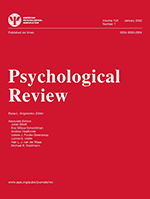
Psychological Review
Psychological Review publishes articles that make important theoretical contributions to any area of scientific psychology. Preference is given to papers that advance theory, but systematic evaluation of alternative theories in a given domain will also be considered for publication. Papers devoted to surveys of the literature, problems of method and design, or reports of empirical findings are not appropriate. The Review also publishes, as Theoretical Notes, commentary that contributes to progress in a given subfield of scientific psychology. Such notes include, but are not limited to, discussions of previously published articles, comments that apply to a class of theoretical models in a given domain, critiques and discussions of alternative theoretical approaches, and metatheoretical commentary on theory testing and related topics.
|
Abstracting and Indexing Services
- Academic Index
- Addiction Abstracts
- Applied Social Science Index & Abstracts
- Biological Abstracts
- Child Development Abstracts
- Current Advances in Ecological & Environmental Sciences
- Current Contents
- Current Index to Journals in Education
- Ergonomics Abstracts
- Index Medicus
- Linguistics & Language Behavior Abstracts
- Management Contents
- PsycINFO
- Social Sciences Citation Index
- Social Sciences Index
- Studies on Women Abstracts
|
|
Instructions to Authors
Manuscript Submission Guidelines
Effective immediately, the Incoming Editor is receiving all new submissions to the journal. Submissions that are accepted will be published in the 2004 volume. Submit manuscripts electronically (RTF or Word format) and mail two copies of the manuscript according to the instructions provided below to:
|
Keith Rayner, PhD
Incoming Editor
Department of Psychology
Tobin Hall
University of Massachusetts
Amherst, Massachusetts 01003
psychrev@psych.umass.edu Email:psychrev@psych.umass.edu |
|
All copies should be clear, readable, and on paper of good quality. An unusual typeface is acceptable only if it is clear and legible. In addition to addresses and phone numbers, authors should supply electronic mail addresses and fax numbers, if available, for potential use by the editorial office and later by the production office. Authors should keep a copy of the manuscript to guard against loss.
Authors may request masked review of their submissions. Each copy of a manuscript to be mask reviewed should include a separate title page with authors' names and affiliations, and these should not appear anywhere else on the manuscript. Footnotes that identify the authors should be typed on a separate page. Authors requesting masked review should make every effort to see that the manuscript itself contains no clues to their identities.
Authors should prepare manuscripts according to the Publication Manual of the American Psychological Association (5th ed.). All manuscripts must include an abstract containing a maximum of 120 words typed on a separate page. Formatting instructions (all copy must be double-spaced) and instructions on preparing tables, figures, references, metrics, and abstracts appear in the Manual. Also, all manuscripts are copyedited for bias-free language (see chap. 2 of the Publication Manual). Original color figures can be printed in color at the editor's discretion and provided the author agrees to pay half of the associated production costs; an estimate of these costs is available from the APA production office on request.
Authors are required to obtain and provide to APA all necessary permissions to reproduce any copyrighted work, including, for example, test instruments and other test materials or portions thereof.
APA policy prohibits an author from submitting the same manuscript for concurrent consideration by two or more publications. In addition, it is a violation of APA Ethical Principles to publish "as original data, data that have been previously published" (Standard 8.13). As this journal is a primary journal that publishes original material only, APA policy prohibits as well publication of any manuscript that has already been published in whole or substantial part elsewhere. Authors have an obligation to consult journal editors concerning prior publication of any data upon which their article depends.
In addition, APA Ethical Principles specify that "after research results are published, psychologists do not withhold the data on which their conclusions are based from other competent professionals who seek to verify the substantive claims through reanalysis and who intend to use such data only for that purpose, provided that the confidentiality of the participants can be protected and unless legal rights concerning proprietary data preclude their release" (Standard 8.14). APA expects authors submitting to this journal to adhere to these standards. Specifically, authors of manuscripts submitted to APA journals are expected to have available their data throughout the editorial review process and for at least 5 years after the date of publication.
Authors will be required to state in writing that they have complied with APA ethical standards in the treatment of their sample, human or animal, or to describe the details of treatment. A copy of the APA Ethical Principles may be obtained electronically or by writing the APA Ethics Office, 750 First Street, NE, Washington, DC 20002-4242.
APA requires authors to reveal any possible conflict of interest in the conduct and reporting of research (e.g., financial interests in a test procedure, funding by pharmaceutical companies for drug research).
Editorial Board
Editor
Walter Mischel
Columbia University
Associate Editors
Marilyn B. Brewer
Ohio State University
Susan Carey
New York University
Barbara Dosher
University of California, Irvine
Lynn Nadel
University of Arizona
Edward E. Smith
University of Michigan
Consulting Editors
John R. Anderson
Carnegie Mellon University
Alan D. Baddeley
University of Bristol, Bristol, England
Albert Bandura
Stanford University
John A. Bargh
New York University
Niall Bolger
New York University
Claus Bundesen
University of Copenhagen, Copenhagen, Denmark
Jerome R. Busemeyer
Indiana University Bloomington
Claudia Carello
University of Connecticut
Daniel P. Cervone
University of Illinois at Chicago
Russell M. Church
Brown University
John Duncan
MRC Cognition and Brain Sciences Unit,
Cambridge, England
Richard Gonzalez
University of Michigan
J. Richard Hackman
Harvard University
Alice F. Healy
University of Colorado at Boulder
Douglas L. Hintzman
University of Oregon
John E. Hummel
University of California, Los Angeles
Larry L. Jacoby
Washington University
Daniel Kahneman
Princeton University
Peter R. Killeen
Arizona State University
Asher Koriat
University of Haifa, Haifa, Israel
Timothy Lee
McMaster University, Hamilton, Ontario, Canada
Stephan Lewandowsky
University of Western Australia,
Nedlands, Western Australia, Australia
Gordon D. Logan
University of Illinois at Urbana¨CChampaign
Maryellen C. MacDonald
University of Wisconsin¡ªMadison
Colin M. MacLeod
University of Toronto, Scarborough, Ontario, Canada
James L. McClelland
Carnegie Mellon University
Barbara Mellers
Ohio State University
Janet Metcalfe
Columbia University
Susan Mineka
Northwestern University
Carolyn C. Morf
National Institute of Mental Health
Richard E. Nisbett
University of Michigan
Robert M. Nosofsky
Indiana University Bloomington
Keith Oatley
University of Toronto, Toronto, Ontario, Canada
John M. Pearce
University of Wales, Cardiff, United Kingdom
Wolfgang Prinz
Max Planck Institute for Psychological Research,
Munich, Germany
Roger Ratcliff
Northwestern University
Daniel L. Schacter
Harvard University
Yuichi Shoda
University of Washington
James Sidanius
University of California, Los Angeles
James T. Townsend
Indiana University Bloomington
Elke Weber
Columbia University
Daniel M. Wegner
University of Virginia
| 







 刊名字顺( Alphabetical List of Journals):
 返回页首
返回页首 