期刊名称:PANMINERVA MEDICA
 期刊简介(About the journal)
投稿须知(Instructions to Authors)
编辑部信息(Editorial Board) 期刊简介(About the journal)
投稿须知(Instructions to Authors)
编辑部信息(Editorial Board)
About the journal
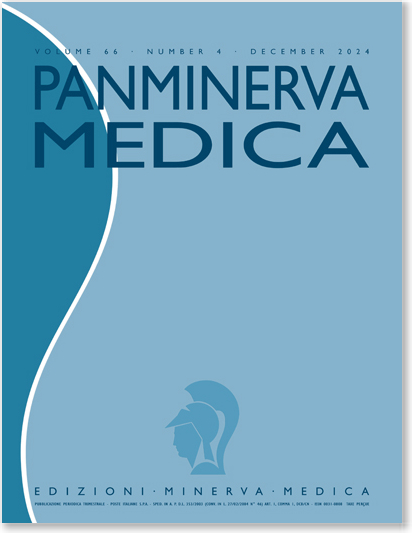
Panminerva Medica
The journal Panminerva Medica publishes scientific papers on clinical and experimental subjects concerning internal medicine.
|
Panminerva Medica
A Journal on Clinical and Experimental Subjects Concerning Internal Medicine
Indexed/Abstracted in: BIOSIS, Current Contents, Index Medicus (MEDLINE), MDS, Research Alert, Science Citation Index |
 |
Instructions to Authors
NOTICE TO AUTHORS
The journal Panminerva Medica publishes scientific papers on clinical and experimental subjects concerning internal medicine.
Contributions may be in the form of editorials, original articles, review articles, case reports, technical notes, therapeutical notes, new technologies, special articles and letters to the Editor.
Manuscripts must be prepared in strict compliance with the instructions for Authors published below. These conform with the Uniform Requirements for Manuscripts Submitted to Biomedical Editors (Ann Intern Med 1997;126:36-47), edited by the International Committee of Medical Journal Editors. Articles not conforming to international standards will not be considered.
Three copies of papers should be sent (including title page, key words, text, figures and tables with legends) with diskette to:
Panminerva Medica
Edizioni Minerva Medica
Corso Bramante, 83-85 - 10126 Torino
Tel. +39 011 678282 - Fax +39 011 674502
or e-mailed to:
journals.dept@minervamedica.it
For on-line submission please save the text in Rich Text Format (RTF) (see the instructions for papers typed using a personal computer).
Submission of the typed manuscript means that the paper has not already been published and, if accepted, will not be published elsewhere either entirely or in part. All illustrations should be original. Illustrations taken from other publications must be accompanied by the permission of the publisher.
The journal adheres to the principles set forth in the Helsinki Declaration and states that all reported research concerning human beings should be conducted in accordance with such principles.
The journal also adheres to the International Guiding Principles for Biomedical Research Involving Animals recommended by the WHO and requires that all research on animals be conducted in accordance with them.
Papers must be accompanied by the following submission letter, signed by all Authors: "The undersigned Authors transfer the ownership of copyright to Panminerva Medica should their work be published in this journal. They state that the article is original, has not been submitted for publication in other journals and has not already been published. They state that they are responsible for the research that they have designed and carried out; that they have participated in drafting and revising the manuscript submitted, which they approve in its contents. They also state that the research reported in the paper was undertaken in compliance with the Helsinki Declaration and the International Principles governing research on animals".
Authors implicitly agree to their paper being submitted to the Editorial Board. In the case of requests for modifications, the new corrected version should be sent to the editorial office either by mail or by e-mail underlining and highlighting the parts that have been modified.
The correction of proofs should be limited to a simple check of the printing; any changes to the text will be charged to the Authors.
Corrected proofs must be sent back within five days to Panminerva Medica - Edizioni Minerva Medica - Corso Bramante 83-85, I-10126 Torino (Italy).
In case of delay, the editorial staff of the journal may correct the proofs on the basis of the original manuscript.
Forms for the ordering of reprints are sent together with the proofs.
Kinds of papers accepted
Editorial. Commissioned by the Editor in Chief or Board of Editors, it must deal with a subject of topical interest regarding which the Author expresses his personal opinion. A maximum of 10 typewritten pages and 30 references will be accepted.
Original articles. These should be original contributions to the subject treated. A maximum of 20 typewritten pages and 60 references will be accepted. The article must be subdivided into the following sections: introduction, materials and methods, results, discussion, conclusions.
In the introduction the aim of the study should be clearly summed up.The materials and methods section should describe in logical sequence how the study was designed and carried out, how the data were analysed (what hypothesis was tested, what type of study was carried out, how randomisation was done, how the subjects were recruited and chosen, provide accurate details of the main features of treatment, of the materials used, of drug dosages, of unusual apparatus, of the statistical method ...). In the results section the answers to the questions posed in the introduction should be given.The results should be reported fully, clearly and concisely with figures, graphs and tables. The discussion section should sum up the main results, critically analyse the methods used, compare the results obtained with other data reported in the literature and discuss the implications of the results.
Review articles. These should discuss a topic of current interest, outline current knowledge of the subject treated, analyse the different opinions regarding the problem discussed, be up-to-date on the latest data in the literature. A maximum of 25 typewritten pages and 100 references will be accepted.
Case reports. These give a description of particularly interesting cases. A maximum of 10 typewritten pages and 30 references will be accepted. The article must be subdivided into the following sections: introduction, case report or clinical series, discussion, conclusions.
Technical notes. Description of a new technique or changes to techniques already in use.A maximum of 10 typewritten pages and 30 references will be accepted.
Therapeutical notes. These are intended for the presentation and assessment of new drugs. A maximum of 10 typewritten pages and 30 references will be accepted. The article must be subdivided into the following sections: introduction, materials and methods, results, discussion, conclusions.
New technologies. These should be critical reviews of new equipment. A maximum of 10 typewritten pages and 30 references will be accepted. The paper must be subdivided into the following sections: introduction, materials and methods, results, discussion, conclusions.
Special articles.These present research projects on the history of medicine, teaching methods and economic and legislative aspects concerning this field.A maximum of 10 typewritten pages and 30 references will be accepted.
Letters to the Editor. These may refer to articles already published in the journal or to a subject of topical interest that the Authors wish to present to readers in a concise form.A maximum of 2 typewritten pages and 5 references will be accepted.
Preparation of manuscripts
The paper should be typed using double spacing and margins of at least 2.5 cm on 212?97 mm format sheets (ISOA4). Type on one side only. The paper must be divided into the following sections:
Title page
- Title: concise but informative, with no abbreviations.
- First name, surname and signatures of the Authors
- Institute and University or Department and Hospital where each Author works.
- Name, address, telephone number and e-mail of the Author to whom all correspondence and proofs should be sent.
- Dates of any congress where the paper has already been presented.
- Mention of any funding or research contracts.
- Acknowledgements.
Abstract and key words
Articles should include an abstract of minimum 200 and maximum 250 words. For original articles, therapeutical notes, new technologies it should be structured into the following sections: background (aim of the study), methods (experimental design, patients and interventions), results (what was found), conclusion (meaning of the study).
Key words should refer to the terms from Medical Subject Headings (MeSH) of the Index Medicus.
No abstracts are requested for Editorials and Letters to the Editor.
Text
Identify methodologies, equipment (give name and address of manufacturer in brackets) and procedures with sufficient details to allow other researchers to reproduce results. Specify well-known methods including statistical procedures; mention and provide a brief description of published methods which are not yet well known; describe new or modified methods at length; justify their use and evaluate their limits.
All drugs should indicate generic name, dose and how administered.
Brand names for drugs should be given in brackets.
Units of measurement, symbols and abbreviations must conform to international standards. Measurements of length, height, weight and volume should be given in metric units (metre, kilogram, litre) or their decimal multiples.
Temperatures must be expressed in degrees Celsius. Blood pressure must be expressed in millimeters of mercury.
All hematological and clinicochemical measurements should be expressed in metric units using the International System of Units (IS).
Authors should avoid using little used symbols and abbreviations. They must however be explained when they first appear in the text.
References
It is expected that all cited references will have been read by the Authors.
The references must contain only the Authors cited in the text, be numbered using Arabic numerals and in the order in which they are first cited. Bibliographical entries in the text should be quoted using bracketed Arabic numerals. References must be set out in the standard format approved by the International Committee of Medical Journal Editors.
Journals
Each entry must specify the Author's surname and initials (list all Authors up to six. If there are seven or more list only the first six names and add "et al."), the article's original title, the name of the Journal (respecting the abbreviations used by Index Medicus), the year of publication, the number of the volume and the number of the first and last pages.
Follow the international standard punctuation carefully when citing references.
Examples:
Standard article.
Sutherland DE, Simmons RL, Howard RJ. Intracapsular technique of transplant nephrectomy. Surg Gynecol Obstet 1978;146:951-2.
Organization as author
International Committee of Medical Journal Editors. Uniform requirements for manuscripts submitted to biomedical journals. Ann Int Med 1988;108:258-65.
nbsp;Issue with supplement
Payne DK, Sullivan MD, Massie MJ. Women's psychological reactions to breast cancer. Semin Oncol 1996;23(1 Suppl 2):89-97.
Books and monographs
For occasional publications the names of the Authors, the title, edition, place, publisher and year of publication must be given.
Examples:
Books by one or more Authors
Rossi G. Manual of Otorhinolaryngology. Turin: Edizioni Minerva Medica; 1987.
Chapter from book
De Meester TR. Gastroesophageal reflux disease. In: Moody FG, Carey LC, Scott Jones R, Ketly KA, Nahrwold DL, Skinner DB, editors. Surgical treatment of digestive diseases. Chicago: Year Book Medical Publishers; 1986.p.132-58.
Congress proceedings
Kimura J, Shibasaki H, editors. Recent advances in clinical neurophysiology. Proceedings of the 10th International Congress of EMG and Clinical Neurophysiology; 1995 Oct 15-19; Kyoto, Japan. Amsterdam: Elsevier; 1996.
Tables
Each table must be submitted on a separate sheet typed correctly and prepared graphically in keeping with the page layout of the journal, numbered in Roman numerals and accompanied by a short title. Notes should be inserted at the foot of the table and not in the title.
Tables should be referenced in the text.
Figures
The photographs must be submitted as glossy prints.
The back of each should have a label showing the number (Arabic numerals), the title of the article, the name of the first Author and orientation (top and bottom) and it should be referenced in the text.
Do not write on the back of the illustrations or scratch or ruin them by using staples.
Reproductions should be limited to the part essential for the purposes of the paper.
Histological photographs should always be accompanied by the magnification ratio and staining method.
Legends should be typed on a separate sheet.
Drawings, graphs and diagrams should be done using a computer.
X-ray examinations must be submitted as photographs on paper.
Electrocardiograms, electroencephalograms etc. must be sent in their original forms or possibly as photographs, never photocopies.
If the figures are in colour it should always be specified whether colour or black and white reproduction is required.
Optimal dimensions for publication in the journal are:
8.6 cm (basis) 4.8 cm (high)
8.6 cm (basis) 9 cm (high)
17.6 cm (basis) 9 cm (high)
17.6 cm (basis) 18.5 cm (high): 1 page.
Instructions for papers typed using a Personal Computer
Three printed copies of the paper, must be enclosed with the floppy disk (Word format).
Disks must be labelled as follows:
a) Author's name
b) Title of paper
c) Word processing program used with version number.
For on-line submission, please save the text in RTF (use the "Save as" function and choose Rich Text Format as file type).
Editorial Board
Chief-Editor
M. L. BENZO
Associate Editor
R. PELLICANO
Editorial Advisory Board
E. AGRIFOGLIO - G. AGRIFOGLIO - C. ALLEGRA - A. AMERIO - C. ANDREOLI - M. ANDREOLI - V. ANDREUCCI - A. ANGELI - P. ARCANGELI - S. ARMENIO - G. AZZENA - P. L. BAIMA-BOLLONE - F. BALSANO - M. BARTOLO - A. BASILE - P. BIGLIOLI - A. BOCCI - B. BOLES CARENINI - F. BOLTRI - A. BOMPIANI - B. BONATI - A. BRANZI - A. BRIENZA - G. BROTZU - A. BRUSCA - R. BULGARELLI - B. CALANDRIELLO - F. CAMANNI - P. P. CAMPA - C. CAMPISI - G. B. CANDIANI - S. CAPONNETTO - P. CAREDDU - M. CASACCIA
G. F. CATOLLA CAVALCANTI - F. CAVAGNINI - P. CAVALLO-PERIN - L. CECILIANI - A. CHERCHI - P. CHERUBINO - M. CHIARIELLO - G. CHIUMELLO - G. CLEMENZIA - S. COCCHERI - M. CONTI - G. CREPALDI - A. DAGIANTI - S. DALLA VOLTA - G. D’AMICO - V. DANESINO - M. DEI POLI - E. DE TONI - G. DI MATTEO - F. DI NOLA - N. DIOGUARDI - G. DISTEFANO - G. DOLCI - L. DONATI - P. FALCONI - G. FERRARIS - G. A. FERUGLIO
L. GAGLIARDI - P. GALLINARO - G. GASBARRINI - P. U. GENNARI - R. GIACOMETTI - E. GIANN?- G. GIORDANO - R. GIORGINO - M. GIOVANNINI - G. GIUFFRIDA - A. GNUDI - F. M. GRIGNOLO - A. IACONO - C. IMPERATO - P. LARIZZA - R. LAURO - F. LAVORATO - A. A. LOTTO - L. MACCHIARELLI - E. MADON - G. MAGGI - B. MAGNANI
R. MAIORCA - G. MANCIA - P. G. MARCHETTI - F. MARCI - M. MARIANI - F. MAROTTI - P. MARRAMA - M. MARTELLI - R. MARTINEZ - L. MARTINI - P. MASI - N. MASSAIOLI - G. MATTIOLI - P. L. MELANOTTE - B. MIOTTI - N. MISASI - R. MODICA - G. M. MOLINATTI - W. MONTORSI - M. MOREA - F. MORINO - M. MOSCARINI - G. MOTTA - A. MUSSA - G. C. MUSSA - N. NIGRO - S. OCCHIPINTI - S. OLIVERO - O. ORLANDI - A. E. PALETTO - L. PARRINI - R. PATTONO - A. PERACCHIA - G. PERETTI - G. PESCETTO - A. PETIZIOL - G. PEZZUOLI - G. PICCOLI - P. PIETRI - F. PIPINO - E. PISANI - M. PORTIGLIATTI BARBOS - P. PRATI - F. RAGAZZINI - R. RAGNI - M. RANDELLI - L. RAVIZZA - M. RIZZETTO - P. RIZZON - A. ROBECCHI - S. ROCCA ROSSETTI - L. ROMANINI - G. ROMEO - F. ROSSI - P. ROSSI - G. ROTONDO - A. RUFFO - M. SANDRUCCI - C. SCANDELLARI - F. SCIARRA - M. SILLA - P. SISMONDI - P. SOLINAS - L. SPOTORNO - S. STIPA - A. TARQUINI - S. TARTARO - A. TIENGO - A. TIZZANI - G. TREVI - E. USAI
G. C. VALLETTA - R. VIGNERI - G. VIOLA - O. VISIOLI - P. ZANNINI
Managing Editor
A. OLIARO
|









 刊名字顺( Alphabetical List of Journals):
 返回页首
返回页首 