期刊名称:INTEGRATIVE AND COMPARATIVE BIOLOGY
 期刊简介(About the journal)
投稿须知(Instructions to Authors)
编辑部信息(Editorial Board) 期刊简介(About the journal)
投稿须知(Instructions to Authors)
编辑部信息(Editorial Board)
About the journal
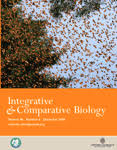
The SICB publishes a bi-monthly journal entitled "Integrative and Comparative Biology", which is one of the most cited and highly respected journals in the field of biology. First published in 1961 as the "American Zoologist", the journal publishes symposia proceedings and abstracts from the Annual Meetings as well as book reviews, reports and special bulletins.
Instructions to Authors
Click here to download these instructions in MS Word (.doc) format for printing.
Editorial Board e-mail address: icbio@u.washington.edu
Editorial Policy
Integrative and Comparative Biology publishes invited, original papers derived principally from symposia sponsored by the Society for Integrative and Comparative Biology (formerly the American Society of Zoologists). Papers should be of general interest to comparative biologists. Specialized terms should be clearly defined, and the general biological significance of results should be stated explicitly.
All manuscripts are subjected to standard, anonymous peer review administered by the editorial office. An invitation to present an oral symposium paper and submit a corresponding manuscript does not guarantee publication.
Manuscripts are accepted with the understanding that the work has not been nor will be submitted for publication elsewhere, and that all authors have read and approved the manuscript. Colleagues cited as sources of personal communication must have approved such citation.
Manuscript Preparation
Submit one hard copy and one pdf file of both the manuscript and figures to the symposium organizer. (The pdf file of manuscript and figures can be sent as e-mail attachments to the symposium organizer, who will forward it to the journal office.) Original figures may be retained for submission with the final, revised manuscript. Double-space all portions of the text, as well as tables, footnotes, figure legends, and references. Margins must be at least 1-inch wide on all sides. Use 12-point font, and left justify the text. Do not use double-sided printing or copying. You may use italics to indicate italics, and use the International System of Units (SI) for weights and measures. As a guide for abbreviations and other stylistic conventions, use Scientific Style and Format: The Council of Biology Editor’s Style Manual for Authors, Editors and Publishers, 6th ed. (Cambridge University Press, Cambridge, New York, 1994).
Headings and Pagination
Begin each major section of the manuscript on a new page in the following order: title page, synopsis, text, acknowledgments, references, footnotes, figure legends, and tables. Standard article format (viz., Introduction, Materials and Methods, Results, and Discussion) may be used if appropriate but isn’t necessary. Number all pages consecutively in the upper right-hand corner, beginning with the title page, and include the name of the first author in the header.
The title page should contain the following information: full title, with superscript number 1 referring to a footnote containing the statement, "From the Symposium on..." (to be completed by the Editor); the full names of all authors, with middle name or initial if used; and authors' complete addresses with postal codes. Include the name, mailing address, e-mail address, and telephone and fax numbers of the 'author to whom editorial correspondence should be addressed' on the title page also. If an address has changed since the work was done, use a superscript number next to the name of the author and a footnote containing, "Present address of is ." Below the title give a running headline (not more than 40 characters) for page headings.
The Synopsis should not normally exceed 250 words. The word "Synopsis" should be typed first, followed by a period.
Primary headings such as INTRODUCTION and DISCUSSION should be centered and set in all capital letters. Subheadings within a primary section should be left justified and underlined.
Citations and References
Please adhere to the style of text citation and reference format used in recent issues of the journal. Abbreviate journal titles according to the World List of Scientific Periodicals. If questions arise in the preparation of the citations and reference list, pencil a "?" in the margin next to the citation or reference in one copy of the manuscript, and mark the copy "For Copy Editor––contains queries."
Articles in press must include the projected year of publication in the text and in the reference section. “In press�appears only in the reference section following the citation.
Unpublished data not yet in press should be cited in the form "(personal communication, J.D. Smith)" or "(unpublished data, R.B.Q.)" with the initials of the author who collected the data if a multi-authored paper. For personal communications, the full name and address of the source should be placed in the References section (above any papers authored by the same person.)
Be sure to check all sources cited in the text with those in the References section, and vice versa.
Footnotes
Use footnotes in the text only when absolutely necessary. Number them consecutively, beginning with the next number after the last footnote on the title page (usually 2 or 3). Group the text footnotes in a section placed after References and before Tables.
Tables
Each table should begin on a separate page. Tables should have concise, descriptive headings. Underline headings to indicate italics. Place any additional explanatory material and references in footnotes. Designate footnotes by superscript, lower-case letters or asterisks, and type footnotes immediately below the table to which they refer.
Figures
All original figures must be submitted with the final, revised manuscript as camera-ready art. Figures should be planned to fit a one-column width (2-5/8�or 67 mm) or a double-column width (5-1/2" or 140 mm). At their final size, figures may not exceed the height of the printed page (8" or 203 mm). Write the author's name, the figure number, an arrow indicating "top," and the requested reduction on the back of each figure. Mark on the manuscript the approximate position in the text where each figure should appear.
Figures and illustrations not in color can ordinarily be included at no extra costs beyond those explained in "Page Charges". Figures and illustrations in color will incur additional charges. Colored material will not be accepted unless payment of these charges has been arranged. Authors anticipating color figures should contact the Editorial Office as early as possible in the review/ publication process to procure cost estimates and arrange for payments.
Use a clear, simple font (e.g., Arial, Futura or Helvetica) for figure lettering. When a figure has several parts, use capital letters (A, B, C, etc.) to designate the parts on the figure and in the text and legends.
Figures are returned to the corresponding author with page proofs and should not be sent back to the journal unless revision is necessary.
Manuscript PRODUCTION
After submitting the final, revised manuscript and original figures the corresponding author will receive page proofs along with the copy-edited manuscript. In the interest of timely publication, changes in proofs are strictly limited to typographic errors. No changes in content or updating are permitted at proof stage without consulting the Editor. Authors will be billed for all changes other than those needed to correct errors introduced during copy editing or typesetting.
Return both the proofs and the copy-edited manuscript to assistant editor Claudia deGruy within 72 hours. If proofs are not returned by author within 72 hours of receipt, proofs will be sent to the printer as is.
Page Charges
The standard length for articles published in Integrative and Comparative Biology is 12 printed pages, which includes text, references, tables, figures, and legends. Authors will be assessed a mandatory charge of $135 for each additional printed page. To estimate the published length of your manuscript, first format your text in 12-point Courier font (compact fonts such as Times will yield an incorrect estimate). Divide the total number of manuscript pages (including tables, references, and figure legends, but excluding figures) by 2.25, then add the space required for all figures at their printed size. An exact calculation of article length cannot be made until the article is set in page proofs.
Reprints may be ordered when the corrected page proofs are returned to the assistant editor, by means of an order form furnished with the proofs. Send this form directly to Allen Press.
Copyright
The copyright for each manuscript must be transferred to the Society for Integrative and Comparative Biology. A Transfer of Copyright form must be returned with the final, revised manuscript.
Submission in Digital Format
In addition to a paper copy, the final, revised manuscript (not figures) must be submitted as a word-processing file on diskette. Please make certain that the paper and diskette copies are identical. Microsoft Word is preferred for Macintosh files and Word Perfect is preferred for DOS or Windows files. Please do not use page layout software such as PageMaker. Avoid using more than minimum formatting so that the file is easily converted. Label the disk with the journal name, symposium name, and author.
Editorial Board
Address of Editorial Office:
Integrative & Comparative Biology
University of Washington, Department of Zoology
146 Kincaid Hall, Box 351800
Seattle, WA 98195-1800
icbio@u.washington.edu
| 







 刊名字顺( Alphabetical List of Journals):
 返回页首
返回页首 